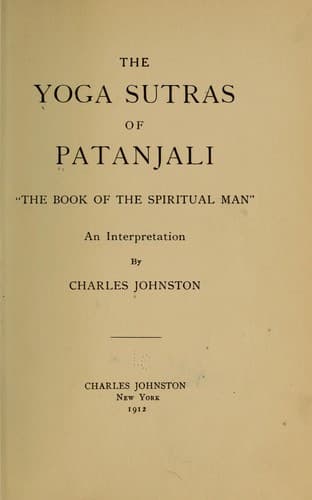
The Yoga Sutras of Patanjali: The Book of the Spiritual ManPatañjali
Religion
The Yoga Sutras of Patanjali: The Book of the Spiritual Man
Patañjali
Yoga -- Early works to 1800
Egotism is but the perversion of spiritual being. Ambition is the
inversion of spiritual power. Passion is the distortion of love. The
mortal is the limitation of the immortal. When these false images give
place to true, then the spiritual man stands forth luminous, as the
sun, when the clouds disperse.
4. Heretofore the Seer has been enmeshed in the activities of the
psychic nature.
The power and life which are the heritage of the spiritual man have
been caught and enmeshed in psychical activities. Instead of pure being
in the Divine, there has been fretful, combative, egotism, its hand
against every man. Instead of the light of pure vision, there have been
restless senses nave been re and imaginings. Instead of spiritual joy,
the undivided joy of pure being, there has been self-indulgence of body
and mind. These are all real forces, but distorted from their true
nature and goal. They must be extricated, like gems from the matrix,
like the pith from the reed, steadily, without destructive violence.
Spiritual powers are to be drawn forth from the psychic meshes.
5. The psychic activities are five; they are either subject or not
subject to the five hindrances (Book II, 3).
The psychic nature is built up through the image-making power, the
power which lies behind and dwells in mind-pictures. These pictures do
not remain quiescent in the mind; they are kinetic, restless,
stimulating to new acts. Thus the mind-image of an indulgence suggests
and invites to a new indulgence; the picture of past joy is framed in
regrets or hopes. And there is the ceaseless play of the desire to
know, to penetrate to the essence of things, to classify. This, too,
busies itself ceaselessly with the mind-images. So that we may classify
the activities of the psychic nature thus:
6. These activities are: Sound intellection, unsound intellection,
predication, sleep, memory.
We have here a list of mental and emotional powers; of powers that
picture and observe, and of powers that picture and feel. But the power
to know and feel is spiritual and immortal. What is needed is, not to
destroy it, but to raise it from the psychical to the spiritual realm.
7. The elements of sound intellection are: direct observation,
inductive reason, and trustworthy testimony.
Each of these is a spiritual power, thinly veiled. Direct observation
is the outermost form of the Soul’s pure vision. Inductive reason rests
on the great principles of continuity and correspondence; and these, on
the supreme truth that all life is of the One. Trustworthy testimony,
the sharing of one soul in the wisdom of another, rests on the ultimate
oneness of all souls.
8. Unsound intellection is false understanding, not resting on a
perception of the true nature of things.
When the object is not truly perceived, when the observation is
inaccurate and faulty, thought or reasoning based on that mistaken
perception is of necessity false and unsound.
Public-domain text, read in full here on John Shaqi.
Reviews
Reviews
No reviews yet
Be the first to share your thoughts on this work.
Join the Discussion
Join the discussion
Sign in to leave a comment or review.
Sign InorCreate an account