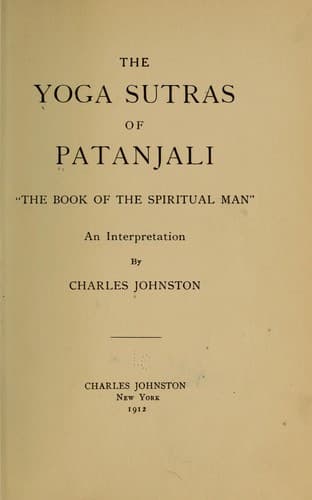
The Yoga Sutras of Patanjali: The Book of the Spiritual ManPatañjali
Religion
The Yoga Sutras of Patanjali: The Book of the Spiritual Man
Patañjali
Yoga -- Early works to 1800
20. But since that on which the thought in the mind of another rests is
not objective to the thought-reader’s consciousness, he perceives the
thought only, and not also that on which the thought rests.
The meaning appears to be simple: One may be able to perceive the
thoughts of some one at a distance; one cannot, by that means alone,
also perceive the external surroundings of that person, which arouse
these thoughts.
21. By perfectly concentrated Meditation on the form of the body, by
arresting the body’s perceptibility, and by inhibiting the eye’s power
of sight, there comes the power to make the body invisible.
There are many instances of the exercise of this power, by mesmerists,
hypnotists and the like; and we may simply call it an instance of the
power of suggestion. Shankara tells us that by this power the popular
magicians of the East perform their wonders, working on the mind-images
of others, while remaining invisible themselves. It is all a question
of being able to see and control the mind-images.
22. The works which fill out the life-span may be either immediately or
gradually operative. By perfectly concentrated Meditation on these
comes a knowledge of the time of the end, as also through signs.
A garment which is wet, says the commentator, may be hung up to dry,
and so dry rapidly, or it may be rolled in a ball and dry slowly; so a
fire may blaze or smoulder. Thus it is with Karma, the works that fill
out the life-span. By an insight into the mental forms and forces which
make up Karma, there comes a knowledge of the rapidity or slowness of
their development, and of the time when the debt will be paid.
23. By perfectly concentrated Meditation on sympathy, compassion and
kindness, is gained the power of interior union with others.
Unity is the reality; separateness the illusion. The nearer we come to
reality, the nearer we come to unity of heart. Sympathy, compassion,
kindness are modes of this unity of heart, whereby we rejoice with
those who rejoice, and weep with those who weep. These things are
learned by desiring to learn them.
24. By perfectly concentrated Meditation on power, even such power as
that of the elephant may be gained.
This is a pretty image. Elephants possess not only force, but poise and
fineness of control. They can lift a straw, a child, a tree with
perfectly judged control and effort. So the simile is a good one. By
detachment, by withdrawing into the soul’s reservoir of power, we can
gain all these, force and fineness and poise; the ability to handle
with equal mastery things small and great, concrete and abstract alike.
25. By bending upon them the awakened inner light, there comes a
knowledge of things subtle, or concealed, or obscure.
Public-domain text, read in full here on John Shaqi.
Reviews
Reviews
No reviews yet
Be the first to share your thoughts on this work.
Join the Discussion
Join the discussion
Sign in to leave a comment or review.
Sign InorCreate an account