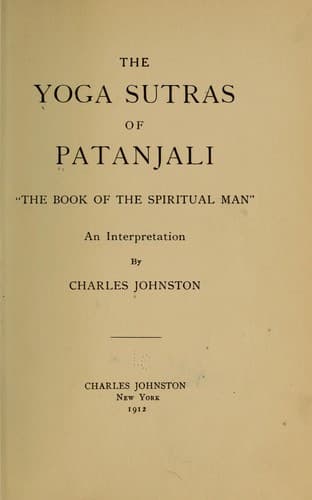
The Yoga Sutras of Patanjali: The Book of the Spiritual ManPatañjali
Religion
The Yoga Sutras of Patanjali: The Book of the Spiritual Man
Patañjali
Yoga -- Early works to 1800
The means for this transfer are described as the weakening of the
causes of bondage, and an understanding of the method of passing from
the one consciousness to the other. The first may also be described as
detach meet, and comes from the conquest of the delusion that the
personal self is the real man. When that delusion abates and is held in
check, the finer consciousness of the spiritual man begins to shine in
the background of the mind. The transfer of the sense of individuality
to this finer consciousness, and thus to the spiritual man, then
becomes a matter of recollection, of attention; primarily, a matter of
taking a deeper interest in the life and doings of the spiritual man,
than in the pleasures or occupations of the personality. Therefore it
is said: “Lay not up for yourselves treasures upon earth, where moth
and rust cloth corrupt, and where thieves break through and steal: but
lay up for yourselves treasures in heaven, where neither moth nor rust
cloth corrupt, and where thieves do not break through nor steal: for
where your treasure is, there will your heart be also.”
39. Through mastery of the upward-life comes freedom from the dangers
of water, morass, and thorny places, and the power of ascension is
gained.
Here is one of the sentences, so characteristic of this author, and,
indeed, of the Eastern spirit, in which there is an obvious exterior
meaning, and, within this, a clear interior meaning, not quite so
obvious, but far more vital.
The surface meaning is, that by mastery of a certain power, called here
the upward-life, and akin to levitation, there comes the ability to
walk on water, or to pass over thorny places without wounding the feet.
But there is a deeper meaning. When we speak of the disciple’s path as
a path of thorns, we use a symbol; and the same symbol is used here.
The upward-life means something more than the power, often manifested
in abnormal psychical experiences, of levitating the physical body, or
near-by physical objects. It means the strong power of aspiration, of
upward will, which first builds, and then awakes the spiritual man, and
finally transfers the conscious individuality to him; for it is he who
passes safely over the waters of death and rebirth, and is not pierced
by the thorns in the path. Therefore it is said that he who would tread
the path of power must look for a home in the air, and afterwards in
the ether.
Of the upward-life, this is written in the Katha Upanishad: “A hundred
and one are the heart’s channels; of these one passes to the crown.
Going up this, he comes to the immortal.” This is the power of
ascension spoken of in the Sutra.
40. By mastery of the binding-life comes radiance.
Public-domain text, read in full here on John Shaqi.
Reviews
Reviews
No reviews yet
Be the first to share your thoughts on this work.
Join the Discussion
Join the discussion
Sign in to leave a comment or review.
Sign InorCreate an account