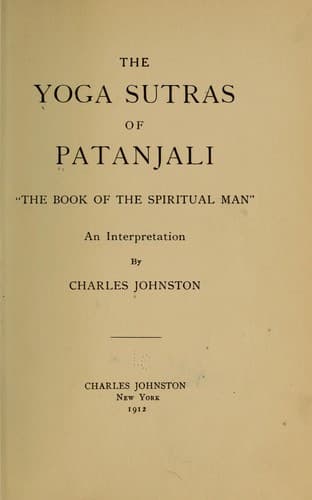
The Yoga Sutras of Patanjali: The Book of the Spiritual ManPatañjali
Religion
The Yoga Sutras of Patanjali: The Book of the Spiritual Man
Patañjali
Yoga -- Early works to 1800
Here is the splendid teaching of oneness that lies at the heart of the
Eastern wisdom. Consciousness is ultimately One, everywhere and
forever. The Eternal, the Father, is the One Self of All Beings. And
so, in each individual who is but a facet of that Self, Consciousness
is One. Whether it breaks through as the dull fire of physical life, or
the murky flame of the psychic and passional, or the radiance of the
spiritual man, or the full glory of the Divine, it is ever the Light,
naught but the Light. The one Consciousness is the effective cause of
all states of consciousness, on every plane.
6. Among states of consciousness, that which is born of Contemplation
is free from the seed of future sorrow.
Where the consciousness breaks forth in the physical body, and the full
play of bodily life begins, its progression carries with it inevitable
limitations. Birth involves death. Meetings have their partings. Hunger
alternates with satiety. Age follows on the heels of youth. So do the
states of consciousness run along the circle of birth and death.
With the psychic, the alternation between prize and penalty is swifter.
Hope has its shadow of fear, or it is no hope. Exclusive love is
tortured by jealousy. Pleasure passes through deadness into pain.
Pain’s surcease brings pleasure back again. So here, too, the states of
consciousness run their circle. In all psychic states there is egotism,
which, indeed, is the very essence of the psychic; and where there is
egotism there is ever the seed of future sorrow. Desire carries bondage
in its womb.
But where the pure spiritual consciousness begins, free from self and
stain, the ancient law of retaliation ceases; the penalty of sorrow
lapses and is no more imposed. The soul now passes, no longer from
sorrow to sorrow, but from glory to glory. Its growth and splendour
have no limit. The good passes to better, best.
7. The works of followers after Union make neither for bright pleasure
nor for dark pain The works of others make for pleasure or pain, or a
mingling of these.
The man of desire wins from his works the reward of pleasure, or incurs
the penalty of pain; or, as so often happens in life, his guerdon, like
the passionate mood of the lover, is part pleasure and part pain. Works
done with self-seeking bear within them the seeds of future sorrow;
conversely, according to the proverb, present pain is future gain.
But, for him who has gone beyond desire, whose desire is set on the
Eternal, neither pain to be avoided nor pleasure to be gained inspires
his work. He fears no hell and desires no heaven. His one desire is, to
know the will of the Father and finish His work. He comes directly in
line with the divine Will, and works cleanly and immediately, without
longing or fear. His heart dwells in the Eternal; all his desires are
set on the Eternal.
Public-domain text, read in full here on John Shaqi.
Reviews
Reviews
No reviews yet
Be the first to share your thoughts on this work.
Join the Discussion
Join the discussion
Sign in to leave a comment or review.
Sign InorCreate an account