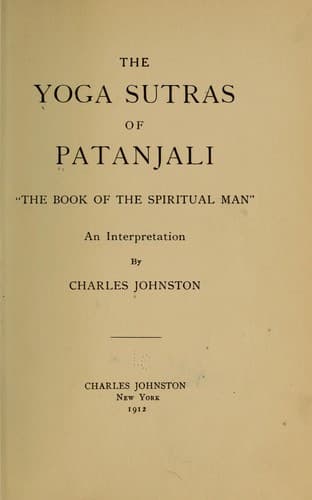
The Yoga Sutras of Patanjali: The Book of the Spiritual ManPatañjali
Religion
The Yoga Sutras of Patanjali: The Book of the Spiritual Man
Patañjali
Yoga -- Early works to 1800
The whole series of dynamic mind-images, which make up the entire
history of the personal man, is a part of the mechanism which the Self
employs, to mirror itself in a reflection, to embody its powers in an
outward form, to the end of self-expression, selfrealization,
self-knowledge. Therefore the initial impulse behind these dynamic
mind-images comes from the Self and is the descending ray of the Self;
so that it cannot be said that there is any first member of the series
of images, from which the rest arose. The impulse is beginningless,
since it comes from the Self, which is from everlasting. Desire is not
to cease; it is to turn to the Eternal, and so become aspiration.
11. Since the dynamic mind-images are held together by impulses of
desire, by the wish for personal reward, by the substratum of mental
habit, by the support of outer things desired; therefore, when these
cease, the self reproduction of dynamic mind-images ceases.
We are still concerned with the personal life in its bodily vesture,
and with the process whereby the forces which have upheld it are
gradually transferred to the life of the spiritual man, and build up
for him his finer vesture in a finer world.
How is the current to be changed? How is the flow of self-reproductive
mind-images, which have built the conditions of life after life in this
world of bondage, to be checked, that the time of imprisonment may come
to an end, the day of liberation dawn?
The answer is given in the Sutra just translated. The driving-force is
withdrawn and directed to the upbuilding of the spiritual body.
When the building impulses and forces are withdrawn, the tendency to
manifest a new psychical body, a new body of bondage, ceases with them.
12. The difference between that which is past and that which is not yet
come, according to their natures, depends on the difference of phase of
their properties.
Here we come to a high and difficult matter, which has always been held
to be of great moment in the Eastern wisdom: the thought that the
division of time into past, present and future is, in great measure, an
illusion; that past, present, future all dwell together in the eternal
Now.
The discernment of this truth has been held to be so necessarily a part
of wisdom, that one of the names of the Enlightened is: “he who has
passed beyond the three times: past, present, future.”
So the Western Master said: “Before Abraham was, I am”; and again, “I
am with you always, unto the end of the world”; using the eternal
present for past and future alike. With the same purpose, the Master
speaks of himself as “the alpha and the omega, the beginning and the
end, the first and the last.”
And a Master of our own days writes: “I feel even irritated at having
to use these three clumsy words—past, present, and future. Miserable
concepts of the objective phases of the subjective whole, they are
about as ill adapted for the purpose, as an axe for fine carving.”
Public-domain text, read in full here on John Shaqi.
Reviews
Reviews
No reviews yet
Be the first to share your thoughts on this work.
Join the Discussion
Join the discussion
Sign in to leave a comment or review.
Sign InorCreate an account