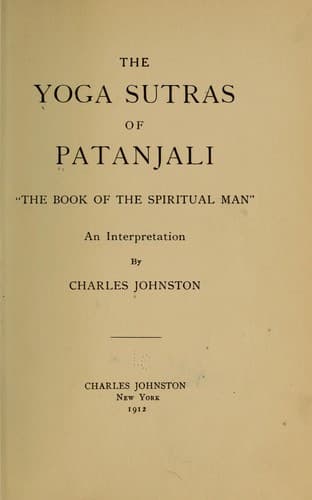
The Yoga Sutras of Patanjali: The Book of the Spiritual ManPatañjali
Religion
The Yoga Sutras of Patanjali: The Book of the Spiritual Man
Patañjali
Yoga -- Early works to 1800
Sickness is included rather for its effect on the emotions and mind,
since bodily infirmity, such as blindness or deafness, is no
insuperable barrier to spiritual life, and may sometimes be a help, as
cutting off distractions. It will be well for us to ponder over each of
these nine activities, thinking of each as a psychic state, a barrier
to the interior consciousness of the spiritual man.
31. Grieving, despondency, bodily restlessness, the drawing in and
sending forth of the life-breath also contribute to drive the psychic
nature to and fro.
The first two moods are easily understood. We can well see bow a sodden
psychic condition, flagrantly opposed to the pure and positive joy of
spiritual life, would be a barrier. The next, bodily restlessness, is
in a special way the fault of our day and generation. When it is
conquered, mental restlessness will be half conquered, too.
The next two terms, concerning the life breath, offer some difficulty.
The surface meaning is harsh and irregular breathing; the deeper
meaning is a life of harsh and irregular impulses.
32. Steady application to a principle is the way to put a stop to
these.
The will, which, in its pristine state, was full of vigour, has been
steadily corrupted by self-indulgence, the seeking of moods and
sensations for sensation’s sake. Hence come all the morbid and sickly
moods of the mind. The remedy is a return to the pristine state of the
will, by vigorous, positive effort; or, as we are here told, by steady
application to a principle. The principle to which we should thus
steadily apply ourselves should be one arising from the reality of
spiritual life; valorous work for the soul, in others as in ourselves.
33. By sympathy with the happy, compassion for the sorrowful, delight
in the holy, disregard of the unholy, the psychic nature moves to
gracious peace.
When we are wrapped up in ourselves, shrouded with the cloak of our
egotism, absorbed in our pains and bitter thoughts, we are not willing
to disturb or strain our own sickly mood by giving kindly sympathy to
the happy, thus doubling their joy, or by showing compassion for the
sad, thus halving their sorrow. We refuse to find delight in holy
things, and let the mind brood in sad pessimism on unholy things. All
these evil psychic moods must be conquered by strong effort of will.
This rending of the veils will reveal to us something of the grace and
peace which are of the interior consciousness of the spiritual man.
34. Or peace may be reached by the even sending forth and control of
the life-breath.
Here again we may look for a double meaning: first, that even and quiet
breathing which is a part of the victory over bodily restlessness; then
the even and quiet tenor of life, without harsh or dissonant impulses,
which brings stillness to the heart.
35. Faithful, persistent application to any object, if completely
attained, will bind the mind to steadiness.
Public-domain text, read in full here on John Shaqi.
Reviews
Reviews
No reviews yet
Be the first to share your thoughts on this work.
Join the Discussion
Join the discussion
Sign in to leave a comment or review.
Sign InorCreate an account