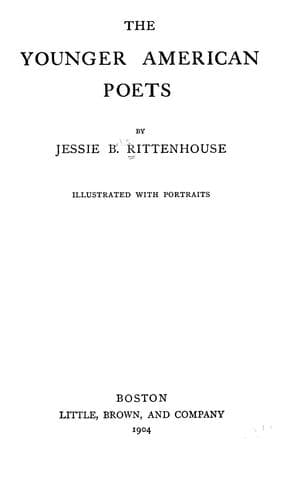
The Younger American PoetsRittenhouse, Jessie Belle
History
The Younger American Poets
Rittenhouse, Jessie Belle
American poetry -- History and criticism; Poets, American
’Twas June on the face of the earth, June with the rose’s breath,
When life is a gladsome thing, and a distant dream is death;
There was gossip of birds in the air, and the lowing of herds by the
wood,
And a sunset gleam in the sky that the heart of a man holds good;
Then the nun-like twilight came, violet-vestured and still,
And the night’s first star outshone afar on the eve of Bunker Hill.
Taking the volume throughout, it is a stirringly sung _résumé_ of all
the chief deeds in American history to which attach valor and romance,
and is not only attractive reading, but should be in the hands of
every lad as a stimulus to patriotism, and to focus in his mind, as
textbooks could never do, the exploits of the brave and the strong.
In the lyrical narrative poem, such as “Guiraut, the Troubadour,” Mr.
Scollard has one of his most characteristic vehicles. The adventures
of the singer who sought a maid in Carcassonne are, no doubt,
romantically enhanced by association of the name with that of the
hapless one who “had not been to Carcassonne;” but it is certain that
one follows the troubadour in his “russet raimentry,” drawn by his
charm as
Unto the gate of Carcassonne
(Ah, how his blithe lips smiled upon
The warded gate of Carcassonne!)
As light of foot as Love he strode;
The budding flowers along the road
Bloomed sudden, with his song for lure;
And softlier the river flowed
Before Guiraut, the troubadour.
* * * * *
Unto a keep in Carcassonne
(No sweeter voice e’er drifted on
That frowning keep in Carcassonne!)
Anon the singer drew anigh,—
but we may not follow his propitious fortunes, glimpsed but to show
the manner of their telling. The parenthetical lines, recurring in
each stanza, impart a peculiar charm to the recital, but the diction
and phrasing, while pleasant and in harmony, have no especial
distinction in themselves, and this illustrates a frequent
characteristic of Mr. Scollard’s work that the melody often carries
the charm rather than the expression or basic theme. He is primarily a
singer, he has the “lute in tune,” and the song is so spontaneous as
sometimes to outsing the motive. There is always a felicitous, and
often unique, turn of phrase and a most imaginative fancy, but one
feels in a good deal of the work a lack of acid; it is too bland to
bite as deeply as it ought. Just a bit sharper tang is needful.
Public-domain text, read in full here on John Shaqi.
Reviews
Reviews
No reviews yet
Be the first to share your thoughts on this work.
Elsewhere in the archive
Join the Discussion
Join the discussion
Sign in to leave a comment or review.
Sign InorCreate an account