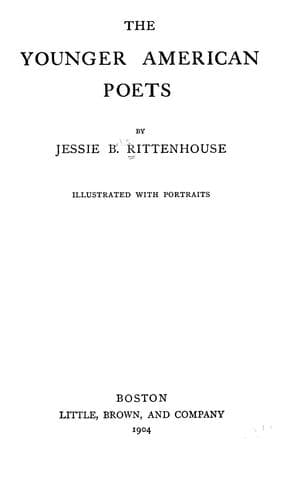
The Younger American PoetsRittenhouse, Jessie Belle
History
The Younger American Poets
Rittenhouse, Jessie Belle
American poetry -- History and criticism; Poets, American
The message should also inform more vitally the melody, wedding more
subtly the outer and inner grace. A poet is a teacher, whether he will
or no, and the heart should be the vital textbook of his expounding.
It is because of their deeper rooting in life, though a life foreign
to us, that the Oriental poems of Mr. Scollard have often greater
vitality than the Occidental ones, whose inspiration is found chiefly
in nature. His ballads show that he has a sympathetic insight into
character and a knowledge of human motive that would, if infused more
widely through his work, give to it a warmth of personal appeal and a
subjectivity which in many of its phases it now lacks. The golden
thread of Joy is woven so constantly into the web of his song that
those whose woof is crossed with the hempen thread of Pain are likely
to feel that he has no word for them, no hint as to the subtle
transformation by which the hempen thread may merge into the gold,
when the finished fabric hurtles from the loom. In other words, Mr.
Scollard’s work is too objective to carry with it the spiritual
meaning that it would if ingrained more deeply in the hidden life of
the soul. Along this line lies its finer development: not that it
shall lose a jot of its cheer, but that it shall constantly inform it
with a richer and deeper meaning.
XV
MARY MCNEIL FENOLLOSA
TO be a poet of the East, one must be a painter, using words as a
colorist uses pigment. His poem must be a picture wherein form and
detail are subjected to the values of tone and atmosphere; like the
dawn-crest of Fujiyama it must glow, it must dazzle with tints and
light. To convert the pen into an artist’s brush, the vocabulary into
a palette, is an end not to be gained by striving; it is a talent _a
priori_, a temperamental color, a temperamental art.
So vividly is this shown in the work of Mrs. Mary McNeil Fenollosa
that whereas in her Eastern poems she is every whit the artist, in her
Western, her Occidental poems, she is without special distinction.
Certain of her Western poems have a conventional, mechanical tone,
while those of the East are abrim with vitality and impulse. They were
not “reared by wan degrees;” the craftsman did not fashion them; and
although varying in charm, there are few that lack the Eastern spirit.
Mrs. Fenollosa’s bit of the Orient is Japan, where nature is ever
coquetting,—laughing in the cherry, sighing in the lotos. Nature in
the Orient is invested with a personality foreign to Western
countries, a personality reminiscent of the gods. Then, too, nature is
given a more prominent place in the poetry of the East than is love,
or any of the subjects, so infinite in variety, which engross a
Western singer; and it happens that Mrs. Fenollosa, catching this
spirit during her life in Japan, gives us chiefly nature poems in her
Eastern collection. With artist-strokes where each is sure, she
flashes this picture before us:
Public-domain text, read in full here on John Shaqi.
Reviews
Reviews
No reviews yet
Be the first to share your thoughts on this work.
Elsewhere in the archive
Join the Discussion
Join the discussion
Sign in to leave a comment or review.
Sign InorCreate an account