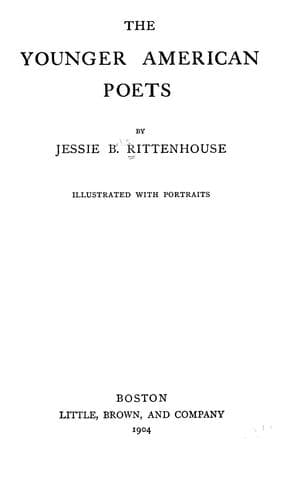
The Younger American PoetsRittenhouse, Jessie Belle
History
The Younger American Poets
Rittenhouse, Jessie Belle
American poetry -- History and criticism; Poets, American
“Thou smell’st not ill, thou object plain,
Thou art a small, pretentious grain
Of amber, I suppose.”
“Nay, my good friend, I am by birth
A common clod of scentless earth….
But I lived with the Rose.”
In the poems of a blither note, Miss Hall excels, having a swift and
sprightly fancy and a clever aptness of phrase, which, in
_Allegretto_, her collection of lighter verse, reveals itself in
charming witticisms and whimsicalities. Her children’s poems are
delicate in touch and fancy, and quaintly humorous. Her lines, “To A
Weed,” in the second collection, tuck away a moral in their sprightly
comment; indeed, a bit of philosophy as to being glad in the sun and
taking one’s due of life, despite limitations, which renders them more
than the merry apostrophe they seem:
You bold thing! thrusting ’neath the very nose
Of her fastidious majesty, the rose,
Even in the best ordainéd garden bed,
Unauthorized, your smiling little head!
The gardener, mind! will come in his big boots,
And drag you up by your rebellious roots,
And cast you forth to shrivel in the sun,
Your daring quelled, your little weed’s life done.
* * * * *
Meantime—ah, yes! the air is very blue,
And gold the light, and diamond the dew,—
You laugh and courtesy in your worthless way,
And you are gay, ah, so exceeding gay!
You argue, in your manner of a weed,
You did not make yourself grow from a seed;
You fancy you’ve a claim to standing-room,
You dream yourself a right to breathe and bloom.
* * * * *
You know, you weed, I quite agree with you,
I am a weed myself, and I laugh too,—
Both, just as long as we can shun his eye,
Let’s sniff at the old gardener trudging by!
In the art of compression, in consistent and restrained imagery, in
clearness and simplicity, and in freedom from affectation, Miss Hall’s
work is altogether commendable. In technique she makes no ambitious
flights, employing almost wholly the more direct and simple forms and
metres, but these suit the intimate mood and singing note of her
themes better than more intricate measures. Technically her chief
defect is in the disregard which she frequently shows for the demands
of metre. I say disregard, for it is evident from the grace of the
majority of her work that she allows herself to depart from metrical
canons at her own will, with the occasional result of jagged lines
which may have seemed more expressive to Miss Hall than those of a
smoother cadence, but which are likely to offend the ear of one
sensitive to rhythm. These lapses are not, however, so frequent or
conspicuous as to constitute a general indictment against the work.
Public-domain text, read in full here on John Shaqi.
Reviews
Reviews
No reviews yet
Be the first to share your thoughts on this work.
Elsewhere in the archive
Join the Discussion
Join the discussion
Sign in to leave a comment or review.
Sign InorCreate an account