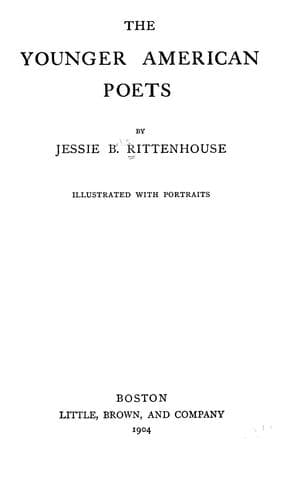
The Younger American PoetsRittenhouse, Jessie Belle
History
The Younger American Poets
Rittenhouse, Jessie Belle
American poetry -- History and criticism; Poets, American
The reflective predominates over the imaginative in the _Age of
Fairygold_, notwithstanding the suggestion of the title. Indeed, there
is a subtly pensive note running through the volume, which remains in
one’s mind as a characteristic impression when the lighter notes are
forgotten. They are not poems of vivid color, imagination, nor
passion, though touched with all. They are not incrusted with verbal
gems, though the diction is fitting and graceful. They have no
daringly inventive metres, though the form is always in harmony with
the thought,—in short, the poems of Miss Hall are such as please and
satisfy without startling. They are leaves from the book of the heart,
and admit us to many a kindred experience. These lines, in which we
must take leave of them, carry the wistful, tender, sympathetic note,
which distinguishes much of her work:
Though true it be these splendid dreams of mine
Are but as bubbles little children blow,
And that Fate laughs to see them wax and shine,
Then holds out her pale finger—and they go:
One bitter drop falls with a tear-like gleam,—
Still, dreaming is so sweet! Still, let me dream!
Though true, to love may be definéd thus:
To open wide your safe defenceless hall
To some great guest full-armed and dangerous,
With power to ravage, to deface it all,
A cast at dice, whether or no he will,—
Still, loving is so sweet! Let me love still!
XVIII
ARTHUR UPSON
WHEN a volume of verse by Mr. Arthur Upson, entitled _Octaves In An
Oxford Garden_, was first brought to my notice by a poet friend with
what seemed before reading it a somewhat extravagant comment as to its
art, it evoked a certain scepticism as to whether the poet in question
would be equally enthusiastic, had he read, marked, learned, and
inwardly digested some eighty or more volumes of verse within a given
period, thus rendering a more rarely flavored compound necessary to
excite anew the poetry-sated appetite; but Mr. Upson’s Octaves proved
to be a brew into which had fallen this magic drop, and moments had
gone the way of oblivion until the charm was drained.
The volume consists of some thirty Octaves written in Wadham Garden at
Oxford in the reminiscent month of September; and so do they fix the
mood of the place that one marvels at the restfulness, the brooding
stillness, the flavor of time and association which Mr. Upson has
managed to infuse into his musing, sabbatical lines. One regrets that
the term “atmosphere” has become so cheapened, for in the exigent
moment when no other will serve as well, he has the depressing
consciousness that virtue has gone from the word he must employ.
Despite this fact, it is atmosphere, in its most pervasive sense, that
imbues Mr. Upson’s Octaves, as the first will attest:
Public-domain text, read in full here on John Shaqi.
Reviews
Reviews
No reviews yet
Be the first to share your thoughts on this work.
Elsewhere in the archive
Join the Discussion
Join the discussion
Sign in to leave a comment or review.
Sign InorCreate an account