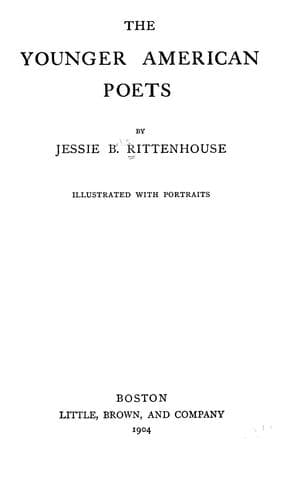
The Younger American PoetsRittenhouse, Jessie Belle
History
The Younger American Poets
Rittenhouse, Jessie Belle
American poetry -- History and criticism; Poets, American
The day was like a Sabbath in a swoon.
Under late summer’s blue were fair cloud-things
Poising aslant upon their charméd wings,
Arrested by some backward thought of June.
Softly I trod and with repentant shoon,
Half fearfully in sweet imaginings,
Where lay, as might some golden court of kings,
The old Quadrangle paved with afternoon.
What else than a touch of genius is in those three words, “paved with
afternoon,” as fixing the tempered light, the drowsy calm, of the
place?
The Octaves are written in groups, the poems of each having a slight
dependence upon one another, so that to be quoted they require the
connecting thought. In many cases also the first or the second
quatrain of the Octave is more artistic than its companion lines, as
in the one which follows, where the first four lines hold the creative
beauty:
As here among the well-remembering boughs,
Where every leaf is tongue to ancient breath,
Speech of the yesteryears forgathereth,
And all the winds are long-fulfilléd vows—
So from of old those ringing names arouse
A whispering in the foliate shades of death,
Where History her golden rosary saith,
Glowing, the light of Memory on her brows.
This Octave illustrates also what may be made as a general statement
regarding its companions in the volume, that while the glamour may not
rest equally upon the poems, they do not lack charm and distinction
even in their less creative touches; and there are few in which there
does not lurk some surprise in the way of picturesque phrasing.
In the ordering of his cadences Mr. Upson shows a musician’s sense of
rhythm; note, for example, how the transposition in the following
lines enhances their melody and conveys in the initial one the sense
of a river flowing:
It was the lip of murmuring Thames along
When new lights sought the wood all strangely fair,
Such quiet lights as saints transfigured wear
In minster windows crept the glades among.
And far as from some hazy hill, yet strong,
Methought an upland shepherd piped it there,
Waking a silvern echo from her lair:
“Sweet Thames, run softly till I end my song!”
Mr. Upson not only obeys by artist instinct the laws of counterpoint,
but employs the word with the music in it, and his effects are
achieved by the innate harmony of his diction and the poetry in the
theme he is shaping. Take as an illustration of this his Octave upon
the “Roman Glassware Preserved in the Ashmolean.” Doubtless those
fragments of crystal, sheathed, by centuries in the earth, in a
translucent film through which shine tints of mother-of-pearl, have
met the eyes of many of us, but it needed a poet to deduce from them
this illustration:
Public-domain text, read in full here on John Shaqi.
Reviews
Reviews
No reviews yet
Be the first to share your thoughts on this work.
Elsewhere in the archive
Join the Discussion
Join the discussion
Sign in to leave a comment or review.
Sign InorCreate an account