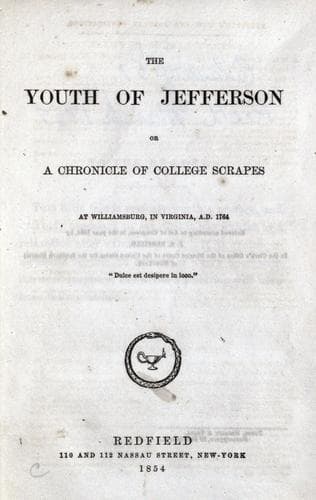
The Youth of Jefferson: Or, a Chronicle of College Scrapes at Williamsburg, in Virginia, A.D. 1764 — John Shaqi
The Youth of Jefferson: Or, a Chronicle of College Scrapes at Williamsburg, in Virginia, A.D. 1764Cooke, John Esten
General
The Youth of Jefferson: Or, a Chronicle of College Scrapes at Williamsburg, in Virginia, A.D. 1764
Cooke, John Esten
Jefferson, Thomas, 1743-1826 -- Fiction
The melancholy Jacques hesitated: a look from Belle-bouche would have
caused him to reply that he regretted exceedingly his inability to
honor his Alma Mater on that particular occasion; but unfortunately
the young girl said nothing. Was she afraid of a second private
interview, wherein the subject should be crooks and shepherdesses,
and the hopes of Corydons? At all events, Belle-bouche played with her
lace cuff, and her countenance wore nothing more than its habitual
faint smile.
Jacques heaved a sigh, and said he believed he ought to go.
The Doctor rose, and pressing Belle-bouche's hand, kindly took his
leave--followed by Jacques, who cast a last longing, lingering look
behind.
As for Sir Asinus, we regret to speak of him. Where were now all his
chivalric thoughts--his noble resolutions--his courage and devotion to
his lady fair? Alas! humanity is weak: we are compelled to say that
the heroic knight, the ardent lover, the iron-hearted rebel, suddenly
changed his device, and took for his crest a lion no longer, only a
hare.
From the back room he emerged into the garden, quaking at every sound;
once in the garden, he stole ignominiously along the hedge; then he
sallied forth into the road; then he mounted his horse, and fled like
the wind.
CHAPTER VI.
HOW SIR ASINUS STAKED HIS GARTERS AGAINST A PISTOLE, AND LOST.
Sir Asinus fled like the wild huntsman, although there was this slight
difference between the feelings of the two characters:--the German
myth was himself the pursuer, whereas Sir Asinus imagined himself
pursued.
He looked around anxiously from time to time, under the impression
that his worthy friend and pedagogue was on his heels; and whenever a
traveller made his appearance, he was complimented with a scrutiny
from the flying knight which seemed to indicate apprehension--the
apprehension of being made a prisoner.
Just as Sir Asinus reached the outskirts of the town, he observed a
chariot drawn by six milk-white horses approaching from a county road
which debouched, like the highway, into Gloucester street; and when
this chariot arrived opposite, a head was thrust through the window,
and a good-humored voice uttered the words:
"Give you good day, my dear Tom!"
Sir Asinus bowed, with a laugh which seemed to indicate familiarity
with the occupant of the carriage, and said:
"Good morning, your Excellency--a delightful day."
"Yes," returned the voice, "especially for a race! What were you
scampering from? Come into the chariot and tell me all about it. I am
dying of weariness."
The movement was soon accomplished. His Excellency's footman mounted
the horse, and Sir Asinus entered the chariot and found himself
opposite an elderly gentleman, very richly clad, and with a smiling
and rubicund face which seemed to indicate a love of the best living.
This gentleman was Francis Fauquier, Governor of his Majesty's loyal
colony of Virginia; and he seemed to be no stranger to the young man.
Public-domain text, read in full here on John Shaqi.
Reviews
Reviews
No reviews yet
Be the first to share your thoughts on this work.
Join the Discussion
Join the discussion
Sign in to leave a comment or review.
Sign InorCreate an account