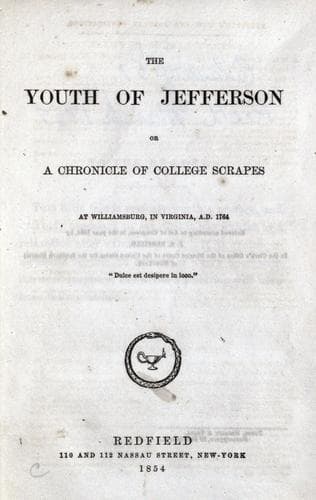
The Youth of Jefferson: Or, a Chronicle of College Scrapes at Williamsburg, in Virginia, A.D. 1764 — John Shaqi
The Youth of Jefferson: Or, a Chronicle of College Scrapes at Williamsburg, in Virginia, A.D. 1764Cooke, John Esten
General
The Youth of Jefferson: Or, a Chronicle of College Scrapes at Williamsburg, in Virginia, A.D. 1764
Cooke, John Esten
Jefferson, Thomas, 1743-1826 -- Fiction
He who had addressed Jacques was Mowbray; the other was Hoffland, the
young student who had just arrived at Williamsburg.
Hoffland is much younger than his companion--indeed, seems scarcely to
have passed beyond boyhood; his stature is low, his figure is slender,
his hair flaxen and curling, his face ornamented only with a
peach-down mustache. He is clad in a suit of black richly embroidered;
wraps a slight cloak around him spite of the warmth of the pleasant
May afternoon; and his cocked hat, apparently too large for him,
droops over his face, falling low down upon his brow.
They walk on for a moment in silence.
Then Hoffland says, in a musical voice like that of a boy before his
tone undergoes the disagreeable change of manhood:
"You have not said how strange you thought this sudden friendship I
express, Mr. Mowbray, but I am afraid you think me very strange."
"No, indeed," replies Mowbray; "I know not why, but you have already
taken a strong hold upon me. Singular! we are almost strangers, but I
feel as though I had known you all my life!"
"That can scarcely be, for I am but seventeen or eighteen," says
Hoffland smiling.
"A frank, true age. I regret that I have passed it."
"Why?"
"Ah, can you ask, Mr. Hoffland?"
"Please do not call me Mr. Hoffland. We are friends: say Charles; and
then I will call you Ernest. I cannot unless you set me the example."
"Ernest? How did you discover my name?"
"Oh!" said Hoffland, somewhat embarrassed, "does not every body know
Ernest Mowbray?"
"Very well--as you are determined to give me compliments instead of
reasons, I will not persist. Charles be it then, but you must call me
Ernest."
"Yes, Ernest."
The low musical words went to his heart, and broke down every barrier.
They were bosom friends from that moment, and walked on in perfect
confidence.
"Why did you regret your youth, Ernest?" said Hoffland. "I
thought young men looked forward impatiently to their full
manhood--twenty-five or thirty; though I do not," he added with a
smile.
"They do; but it is only another proof of the blindness of youth."
"Is youth blind?"
"Blind, because it cannot see that all the delights of ambition, the
victories of mind, the triumphs and successes of the brain, are mere
dust and ashes compared with what it costs to obtain them--the
innocence of the heart, the illusions of its youthful hope."
"Ah! are illusions to be desired?"
"At least they are a sweet suffering, a bitter delight."
"Even when one wakes from them to find every thing untrue--despair
alone left?"
Public-domain text, read in full here on John Shaqi.
Reviews
Reviews
No reviews yet
Be the first to share your thoughts on this work.
Join the Discussion
Join the discussion
Sign in to leave a comment or review.
Sign InorCreate an account