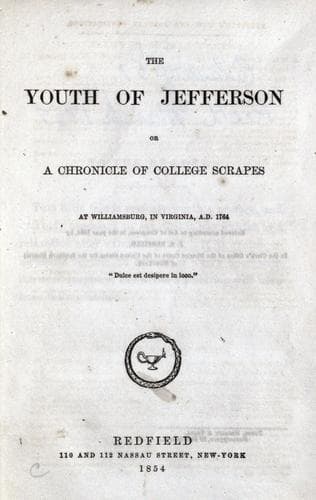
The Youth of Jefferson: Or, a Chronicle of College Scrapes at Williamsburg, in Virginia, A.D. 1764Cooke, John Esten
General
The Youth of Jefferson: Or, a Chronicle of College Scrapes at Williamsburg, in Virginia, A.D. 1764
Cooke, John Esten
Jefferson, Thomas, 1743-1826 -- Fiction
"Well, well," he continued at length, "I saw her often. I could not
strangle my feelings. I loved her--in spite of her wealth--not on
account of it. But gradually my sentiment moderated: like a whip of
scorpions, this suspicion she felt struck me, wounding my heart and
inflaming my pride. I tried to stay away; I dragged through life for a
week without seeing her; then, impelled by a violent impulse, I went
to her again, armed with an impassible pride, and determined to
converse upon the most indifferent subjects--to test her nature fully,
and--to make the test complete--bend all the energies of my mind to
the task of weighing her words, her looks, her tones, that I might
make a final decision. Well, she almost distinctly intimated, fifteen
minutes after our interview commenced, that I was a fortune-hunter
whom she regarded with a mixture of amusement and contempt."
"Oh, sir! could it have been that you----"
The boy stopped.
"How unhappy she must be--to have to suspect such noble natures as
your own," he added in a low voice.
Mowbray turned away his head; then by a powerful effort went on.
"You shall judge, Charles," he said in a voice which he mastered only
by a struggle; "you shall say whether I am correct in my opinion of
her thoughts. She asked me plainly if I was poor; to which question I
replied with a single word--'Very.' Next, did I hope to become rich! I
did hope so. Her advice then was, she said, that I should marry some
heiress, since that was a surer and more rapid means than law or
politics. She said it very satirically, and with a glance which killed
my love----"
"Oh, sir!" the boy murmured.
"Yes; and though I was calm, my face not paler, I believe, than usual,
I was led to say what I bitterly regret--not because it was untrue,
for it was not, rather was it profoundly true--but because it might
have been misunderstood. It was disgraceful to marry for mere wealth,
I said; and I added, 'too expensive'--since unhappiness at any price
was dear. I added that money would never purchase my own
heart--school-boy fashion, you perceive; and then I left her--never to
return."
A long silence followed these words. Mowbray then added calmly:
"You deduce from this narrative, Charles, one lesson. Never give your
affections to a woman suddenly; never make a young girl whom you do
not know the queen of your heart--the fountain of your illusions and
your dreams. The waking will be unpleasant; pray Heaven you may never
wake as I have with a mind which is becoming sour--a heart which is
learning to distrust whatever is most fair in human nature. Let us
dismiss the subject now. I am glad I felt this impulse to open my
heart to you, a stranger, though a friend. We often whisper into a
strange ear what our closest friends would ask in vain. See, there is
his Excellency's chariot with its six white horses, and look what a
graceful bow he makes us!"
Mowbray walked on without betraying the least evidence of emotion. He
seemed perfectly calm.
Public-domain text, read in full here on John Shaqi.
Reviews
Reviews
No reviews yet
Be the first to share your thoughts on this work.
Join the Discussion
Join the discussion
Sign in to leave a comment or review.
Sign InorCreate an account