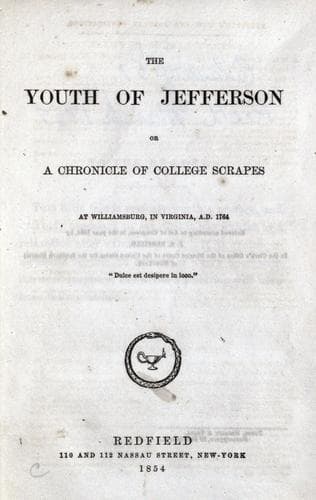
The Youth of Jefferson: Or, a Chronicle of College Scrapes at Williamsburg, in Virginia, A.D. 1764 — John Shaqi
The Youth of Jefferson: Or, a Chronicle of College Scrapes at Williamsburg, in Virginia, A.D. 1764Cooke, John Esten
General
The Youth of Jefferson: Or, a Chronicle of College Scrapes at Williamsburg, in Virginia, A.D. 1764
Cooke, John Esten
Jefferson, Thomas, 1743-1826 -- Fiction
He approaches smiling, modest, humble--a consummate strategist; his
ambrosial curls and powdered queue tied with its orange ribbon,
shining in the sun. He wears a suit of cut velvet with gold buttons; a
flowered satin waistcoat reaching to his knees; scarlet silk
stockings, and high-heeled worsted shoes. His cuffs would enter a
barrel with difficulty, and his chin reposes upon a frill of
irreproachable Mechlin lace.
Jacques finds the eyes suddenly turned upon him, and bows low. Then he
approaches, falls upon one knee, and presses his lips gallantly to the
hand of the little beauty, who smiling carelessly rises in a measure
from her recumbent position.
"Do I find the fair Belinda reading?" says the gallant; "what blessed
book is made happy by the light of her eyes?"
Which remarkable words, we must beg the reader to remember, were after
the fashion of the time and scarcely more than commonplace. The fairer
portion of humanity had even then perfected that sovereignty over the
males which in our own day is so very observable. So, instead of
replying in a tone indicating surprise, the little beauty answers
quite simply:
"My favorite--Lovelace."
Jacques heaves a sigh; for the music of the voice has touched his
heart--nay, overwhelmed it with a new flood of love.
He dangles his bonnet and plume, and carefully arranges a drop curl.
He, the prince of wits, the ornament of ball rooms, the star of the
minuet and reel, is suddenly quite dumb, and seems to seek for a
subject to discourse upon in surrounding objects.
A happy idea strikes him; a thought occurs to him; he grasps at it
with the desperation of a drowning man. He says:
"'Tis a charming day, fairest Belle-bouche--Belinda, I mean. Ah,
pardon my awkwardness!"
And the unhappy Corydon betrays by his confusion how much this slip of
the tongue has embarrassed him--at least, that he wishes her to think
so.
The little beauty smiles faintly, and bending a fatal languishing
glance upon her admirer, says:
"You called me--what was it?"
"Ah, pardon me."
"Oh certainly!--but please say what you called me."
"How can I?"
"By telling me," says the beauty philosophically.
"Must I?" says Jacques, reflecting that after all his offence was not
so dreadful.
"If you please."
"I said Belle-bouche."
"Ah! that is----?"
"Pretty-mouth," says Lovelace, with the air of a man who is caught
feloniously appropriating sheep; but unable to refrain from bending
wistful looks upon the topic of his discourse.
Belle-bouche laughs with a delicious good humor, and Jacques takes
heart again.
"Is that all?" she says; "but what a pretty name!"
"Do you like it, really?" asks the forlorn lover.
"Indeed I do."
"And may I call you Belle-bouche?"
"If you please."
Jacques feels his heart oppressed with its weight of love. He sighs.
This manoeuvre is greeted with a little laugh.
"Oh, that was a dreadful heigho!" she says; "you must be in love."
"I am," he says, "desperately."
Public-domain text, read in full here on John Shaqi.
Reviews
Reviews
No reviews yet
Be the first to share your thoughts on this work.
Join the Discussion
Join the discussion
Sign in to leave a comment or review.
Sign InorCreate an account