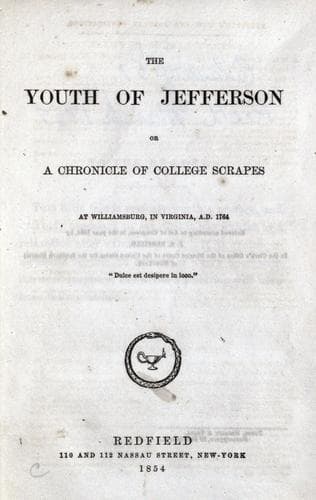
The Youth of Jefferson: Or, a Chronicle of College Scrapes at Williamsburg, in Virginia, A.D. 1764 — John Shaqi
The Youth of Jefferson: Or, a Chronicle of College Scrapes at Williamsburg, in Virginia, A.D. 1764Cooke, John Esten
General
The Youth of Jefferson: Or, a Chronicle of College Scrapes at Williamsburg, in Virginia, A.D. 1764
Cooke, John Esten
Jefferson, Thomas, 1743-1826 -- Fiction
Philippa is a lady of nineteen or twenty, with the air of a duchess
and the walk of an antelope. Her brilliant eyes, as black as night,
and as clear as a sunny stream, are full of life, vivacity and
mischief; she seems to be laughing at life, and love, and gallantry,
and all the complimentary nothings of society, from the height of her
superior intellect, and with undazzled eyes. She is clad even more
richly than Belle-bouche, for Philippa is an heiress--the mistress of
untold farms--or plantations as they then said;--miles of James River
"low grounds" and uncounted Africans. Like the Duke of Burgundy's, her
sovereignty is acknowledged in three languages--the English, the
African or Moorish, and the Indian: for the Indian settlement on the
south side calls her mistress, and sends to her for blankets in the
winter. In the summer it is not necessary to ask for the produce of
her estate, such as they desire--they appropriate it.
Philippa is a cousin of Belle-bouche; and Belle-bouche is the niece of
Aunt Wimple, who is mistress of the Shadynook domain. Philippa has
guardians, but it cannot be said they direct her movements. They have
given up that task in despair, some years since, and only hope that
from the numerous cormorants always hovering around her, she may
select one not wholly insatiable--with some craw of mercy.
"There, you are talking about flowers, I lay a wager," she says,
returning the bow of Jacques, and laughing.
"I was speaking neither of yourself nor the fair Belinda," replies
Jacques, with melancholy gallantry.
"There! please have done with compliments--I detest them."
"You detest every thing insincere, I know, charming Philippa--pardon
me, but your beautiful name betrays me constantly. Is it not--like
your voice--stolen from poetry or music?"
"Ah, sir, you are insufferable."
"Pardon, pardon--but in this beautiful and fair season, so full of
flowers----"
"You think it necessary to employ flowers of speech: that is what you
were going to say, but for heaven's sake have done."
Jacques bows.
"I have just discarded the twentieth, Bel," she adds, laughing; "he
got on his knees."
And Philippa laughs heartily.
Jacques is used to his companion's manner of talking, and says:
"Who was it, pray, madam--Mowbray?"
A flush passes over Philippa's face, and she looks away, murmuring
"No!"
"I won't go over the list of your admirers," continues Jacques, sadly,
"they are too numerous; for who can wonder at such a fairy face as
yours attracting crowds of lovers?"
"My fairy face? Yes, and my unhappy wealth, sir. I wish I was poor! I
can never know when I am loved truly. Oh, to know that!"
And a shadow passes over the face, obliterating the satire, and
veiling the brilliant eyes. Then with an effort Philippa drives away
her preoccupation, and says:
"I wish Heaven had made me a man!"
"A man?" says Jacques.
"Yes, sir."
Public-domain text, read in full here on John Shaqi.
Reviews
Reviews
No reviews yet
Be the first to share your thoughts on this work.
Join the Discussion
Join the discussion
Sign in to leave a comment or review.
Sign InorCreate an account