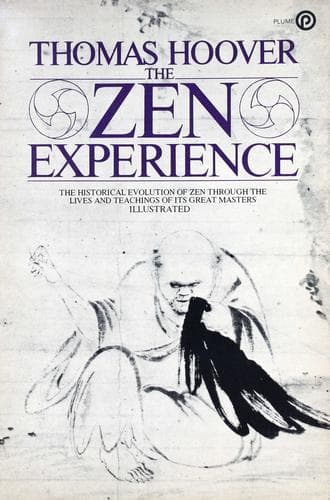
Kaso responded, "Well, then, you really are a Master after all."16
Although it was customary for monks to receive a certificate from their
master attesting to their enlightenment, the matter of Ikkyu's
certificate is problematical. He himself refused to give out
certificates, and he is depicted in Bokusai's chronicle as periodically
taking out his own and requesting it be destroyed by his disciples--
after which it seemed to miraculously appear again several years later.
The quantity of invention and accretion attached to Ikkyu's
disappearing certificate has fostered speculation that he never, in
fact, actually received a seal.
In any case, he probably would have destroyed his own seal of
enlightenment in later years. His life grew progressively more
unconventional with time, just the opposite of most. Beginning as a
classicist in the finest Kyoto tradition, he had gone on to become a
spiritual recluse in the mountains under a harsh meditation master.
After all this training he then took the road, becoming a wandering
monk in the traditional T'ang mode.
Well, almost in the traditional mode. He seemed to wander into brothels
and wine shops almost as often as into Zen temples. He consorted with
high and low, merchant and commoner, male and female. Our record of
these explorations, both geographic and social, is in his writings,
particularly his poetry. He also harbored a vendetta against the
complacency and corruption of Japanese Zen and its masters,
particularly the new abbot of Daitoku-ji, an older man named Yoso who
had once been a fellow disciple of his beloved Kaso.
When Ikkyu was forty-six he was invited by Yoso to head a subtemple in
the Daitoku-ji compound. He accepted, much to the delight of his
admirers, who began bringing the temple donations in gratitude.
However, after only ten days Ikkyu concluded that Daitoku-ji too had
become more concerned with ceremony than with the preservation of Zen,
and he wrote a famous protest poem as a parting gesture--claiming he
could find more of Zen in the meat, drink, and sex traditionally
forbidden Buddhists.
_For ten days in this temple my mind's been in turmoil,
My feet are entangled in endless red tape.
If some day you get around to looking for me,
Try the fish-shop, the wine parlor, or the brothel.17
_
Ikkyu's attack on the commercialization of Zen was not without cause.
The scholar Jan Covell observes that in Ikkyu's time, "Rinzai Zen had
sunk to a low point and enlightenment was 'sold,' particularly by those
temples associated with the Shogunate. Zen temples also made money in
sake-brewing and through usury. In the mid-fifteenth century one Zen
temple, Shokoku-ji, furnished all the advisers to the Shogunate's
government and received most of the bribes. The imperial-sanctioned
temple of Daitoku-ji was only on the fringe of this corruption, but
Ikkyu felt he could not criticize it enough."18
Public-domain text, read in full here on John Shaqi.
Reviews
Reviews
No reviews yet
Be the first to share your thoughts on this work.
Elsewhere in the archive
Join the Discussion
Join the discussion
Sign in to leave a comment or review.
Sign InorCreate an account