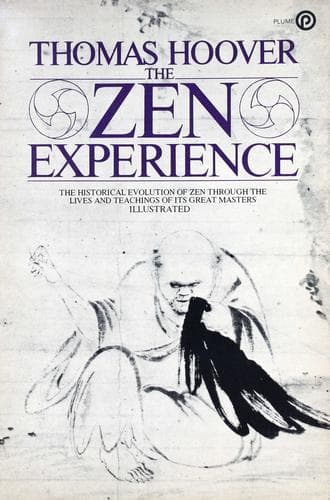
Lu-ch'iu Yin anxiously pressed on to the kitchen, where sure enough he
found Han-shan and Shih-te, tending the stoves and warming themselves
over the fire. When he bowed low to them, they broke into gales of
laughter and shouted "HO" back at him. The other monks were scandalized
and wondered aloud why a distinguished official would bow to a pair of
ne'er-do-wells. But before he could explain, the pair clasped hands and
bolted out of the temple. (The giggling Han-shan and Shih-te became a
staple of Zen art for a millennium thereafter.) Determined to retrieve
them, he arranged for the monastery to provide them permanent
accommodations and left a package of clothes and incense for them. When
they failed to reappear, he had a bearer carry his gifts and accompany
him up into the mountains. Finally they glimpsed Han-shan, who yelled,
"Thief! Thief!" at them and retreated to the opening of a cave. He then
bade them farewell with, "Each of you men should strive to your
utmost!" Whereupon he disappeared into the cave, which itself then
closed upon him, leaving no trace. The preface says Han-shan was never
seen again. In homage the disappointed Lu-ch'iu Yin had his poems
collected from where they had been composed--on scraps of bamboo, wood,
stones, cliffs, and on the walls of houses. Thus there came to be the
collected _oeuvre _of Han-shan.
Han-shan's poems support at least part of this somewhat fanciful story.
He does seem to have been Buddhist in outlook, and as one of his
translators, Burton Watson, has declared, ". . . to judge from his
poetry, Han-shan was a follower of the Ch'an sect, which placed great
emphasis on individual effort and was less wary of emotionalism than
earlier Buddhism had been. . . . Though he writes at times in a mood of
serenity, at other times he appears despondent, angry, arrogant, or
wildly elated. . . ,"27
As did Layman P'ang, Han-shan seems to have believed that the Way is
found in everyday-mindedness, a point of view most forcefully expounded
by Ma-tsu. As Han-shan declares in one of his poems:
_As for me, I delight in the everyday Way,
Among mist-wrapped vines and rocky caves.
Here in the wilderness I am completely free,
With my friends, the white clouds, idling forever.
There are roads, but they do not reach the world;
Since I am mindless, who can rouse my thoughts?
On a bed of stone I sit, alone in the night,
While the round moon climbs up Cold Mountain.28 _
Many of his verses reinforce the belief that he was indeed a follower
of Southern Ch'an. For example, he seemed to believe that the mind
itself is the Buddha that all seek.
_Talking about food won't make you full,
Babbling of clothes won't keep out the cold.
A bowl of rice is what fills the belly;
It takes a suit of clothing to make you warm.
And yet, without stopping to consider this,
You complain that Buddha is hard to find.
Turn your mind within! There he is!
Why look for him abroad?29
_
Public-domain text, read in full here on John Shaqi.
Reviews
Reviews
No reviews yet
Be the first to share your thoughts on this work.
Elsewhere in the archive
Join the Discussion
Join the discussion
Sign in to leave a comment or review.
Sign InorCreate an account