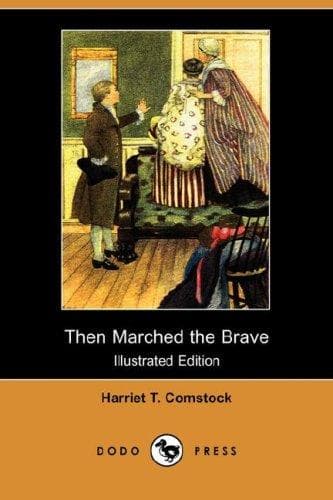
Then Marched the BraveComstock, Harriet T. (Harriet Theresa)
General
Then Marched the Brave
Comstock, Harriet T. (Harriet Theresa)
Hale, Nathan, 1755-1776 -- Juvenile literature; Long Island, Battle of, New York, N.Y., 1776 -- Juvenile fiction
Ruth watched him closely. "I'm not over-curious," she faltered, "but I
fear for you. If he--if he were a spy you were seen with him far too
often for your good. Father even feared for me."
"Ruth" (Andy's voice had a new tone), "I can believe no dishonor of the
master, and I am proud that I walked with him and was his friend!"
"Aye" (Ruth looked doubtful), "but a spy is not a good thing, Andy, no
matter what shape it takes."
Old, rigid training held them both, but Andy must defend his friend,
though the honest soul of Ruth shone from her eyes, and challenged him.
"It is as a thing is used," he began, lamely, but seeing his way dimly.
"Father does not preach that," Ruth broke in.
"No; nor would I preach it," sighed Andy.
"But you would act it?" Ruth flashed.
"I do--not know. I cannot think the master was aught but honest. If he
were--were--" Andy could not use the hard word--"if he were finding
things out, you may be sure, Ruth, it was not for his own uplifting. If
he gave what other men would call--would call their honor--it was
because he held not even _that_ from his country. I can--see--how--that
could--be!"
Ruth raised her eyes. "Could you, Andy?" she said.
"Yes. I could give it as I could my life. I would take no recompense, I
would just give, and do anything. Ruth, suppose you knew a truth
about--about--well, about me; a truth that, if it were known, would be
the death of me. Would you tell, or--or would you save me?"
It was a rigid moment for the stern little maid. Her eyes fell, then
were raised again.
"I--do--not--know," she panted, "but a lie is a lie, and I should expect
to be punished."
"So should I for any dishonorable thing," agreed Andy. "That is just
it, but it would be my willingness to do it, and then to suffer, that
makes the difference."
The two were standing near the end of the Pass at a small gate, and as
Andy ceased speaking a sound smote their ears that turned them pale. It
was the sound of many horsemen galloping wildly onward.
"The king's men landed at Kip's Bay this morning," gasped Andy,
clutching the gate, "and they do say that Douglass's men are not strong
enough to defend the point."
It was Putnam's five brigades; the boy and girl only knew they were
patriot troops. They had been ordered by Washington to make for
Manhattanville before retreat was cut off.
Young Aaron Burr was acting as guide. The master had once pointed him
out to Andy, and the boy remembered the face well. Boldly and fearlessly
he was riding, and Andy's voice broke into a cheer as he recognized the
noble face. The leaders halted. There were several roads ahead; which
was safest and quickest? Burr ventured a question.
"Which way leads most directly to Manhattanville?" he said.
"Keep close to the river, and make for Kingsbridge, Colonel," Andy
answered. "That road is not so carefully watched; it is rougher but
safer."
Public-domain text, read in full here on John Shaqi.
Reviews
Reviews
No reviews yet
Be the first to share your thoughts on this work.
Join the Discussion
Join the discussion
Sign in to leave a comment or review.
Sign InorCreate an account