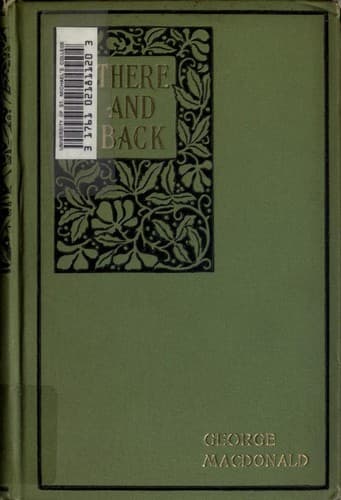
Christian fiction; Wingfold, Thomas (Fictitious character) -- Fiction
A gentleman who employed Richard, happened one day, in conversation with
him as he pursued his work, to start the subject of music, and made a
remark which, notwithstanding Richard's ignorance, found sufficient way
into his mind to make him think over what little experience he had had
of sweet sounds, ere he made his reply. When made, it revealed in
truth his ignorance, but his modesty as well, and his capacity for
understanding--with the result that the gentleman, who was not only a
lover of music but a believer in it, said to him in return things which
roused in him such a desire to put them to the test for verification or
disapproval, that he went the next Monday night to the popular concert
at St. James's Hall. In the crowd that waited more than an hour at the
door of the orchestra to secure a shilling-place, there was not one that
knew so little of music as he; but there never had been in it one whose
ignorance was more worthy of destruction. The first throbbing flash of
the violins cleft his soul as lightning cleaves a dark cloud, and set
his body shivering as with its thunder--and lo, a door was opened in
heaven! and, like the writhings of a cloud in the grasp of a heavenly
wind, all the discords of spirit-pain were breaking up, changing, and
solving themselves into the song of the violins! After that, he went
every Monday night to the same concert-room. It was his church, the
mount of his ascension, the place whence he soared--no, but was lifted
up to what was as yet his highest consciousness of being. All that was
best and simplest in him came wide awake as he sat and listened. What
fact did the music prove? None whatever. Yet would not the logic of all
science have persuaded Richard that the sea of mood and mystic response,
tossing his soul hither and thither on its radiant waters, as, deep unto
deep, it answered the marching array of live waves, fashioned one by one
out of the still air, marshalled and ranked and driven on in symmetric
relation and order by those strange creative powers with their curious
symbols, throned at their godlike labour--that the answer of his soul,
I say, was but an illusion, the babble of a sleeping child in reply to
a question never put. If it was an illusion, how came it that such
illusion was possible? If an illusion, whence its peculiar bliss--a
bliss aroused by law imperative that ruled its factors, yet bore scant
resemblance to the bliss? What he felt, he knew that he felt, and
knew that he had never caused it, never commanded its presence, never
foreseen its arrival, never known of its possible existence. The feeling
was _in him_, but had been waked by some power _beyond him_, for he was
not himself even present at its origin! The voice of that power was a
voice all sweetness and persuading, yet a voice of creation, calling
up a world of splendour and delight, the beams of whose chambers were
indeed laid upon the waters, but had there a foundation the less lively
earth could not afford.
Public-domain text, read in full here on John Shaqi.
Reviews
Reviews
No reviews yet
Be the first to share your thoughts on this work.
Elsewhere in the archive
Join the Discussion
Join the discussion
Sign in to leave a comment or review.
Sign InorCreate an account