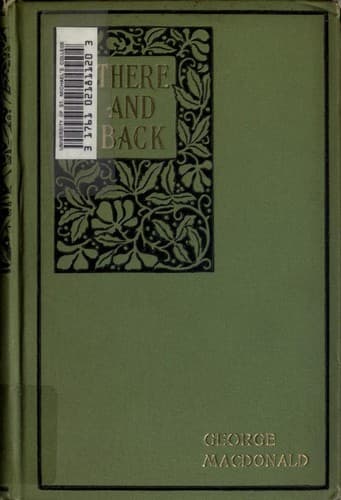
Christian fiction; Wingfold, Thomas (Fictitious character) -- Fiction
For the very essence of the creative voice,
working wildest delirium of content, was law that could not be broken,
the very law of the thought of God himself. Law is life, for God is law,
and God is life. Law is the root and the stalk of life, beauty is the
flower of life, and joy is its odour; but life itself is love. The
flower and its odour are given unto men; the root and stalk they may
search into if they will; the giver of life they must know, or they
cannot live with his life, they cannot share in the life eternal.
One night, after many another such, he sat entranced, listening to the
song of a violin, alone and perfect, soaring and sailing the empyrean
unconvoyed,--and Barbara in his heart was listening with him. He had
given up hope of seeing her again in this world, but not all hope of
seeing her again somewhere; and her image had not grown less dear, I
should rather say less precious to him. The song, like a heavenly lark,
folded its wings while yet high in the air, and ceased: its nest was
somewhere up in the blue. Should I say rather that one after one the
singing birds flitted from the strings, those telegraph wires betwixt
the seen and the unseen, and now the last lingerer was gone? All was
over, and the world was still. But the face of Barbara kept shining from
the depths of Richard's soul, as if she stood behind him, and her face
looked up reflected from its ethereal ocean.
All at once he was aware that his bodily eyes were resting on the bodily
face of Barbara. It was as if his strong imagining of her had made her
be. His heart gave a great bound--and stood still, as if for eternity.
But the blood surged back to his brain, and he knew that together they
had been listening to the same enchanting spell, had been aloft together
in the same aether of delight: heaven is high and deep, and its lower
air is music; in the upper regions the music may pass, who knows,
merging unlost, into something endlessly better! He had felt, without
knowing it, the power of her presence; it had been ruling his thoughts!
He gazed and gazed, never taking his eyes from her but for the joy of
seeing her afresh, for the comfort of their return to their home. She
was so far off that he could gaze at will, and thus was distance a
blessing. Not seldom does removal bring the parted nearer. It is not
death alone that makes “far-distant images draw nigh,” but distance
itself is an angel of God, mediating the propinquity of souls. As he
gazed he became aware that she saw him, and that she knew that he saw
her. How he knew it he could not have told. There was no change on her
face, no sign of recognition, but he knew that she saw and knew. In his
modesty he neither perceived nor imagined more. His heart received no
thrill from the pleasure that throbbed in the heart of the lovely lady
at sight of the poor sorrowful workman; neither did she in her modesty
perceive on what a throne of gems she sat in his heart. She saw that his
Public-domain text, read in full here on John Shaqi.
Reviews
Reviews
No reviews yet
Be the first to share your thoughts on this work.
Elsewhere in the archive
Join the Discussion
Join the discussion
Sign in to leave a comment or review.
Sign InorCreate an account