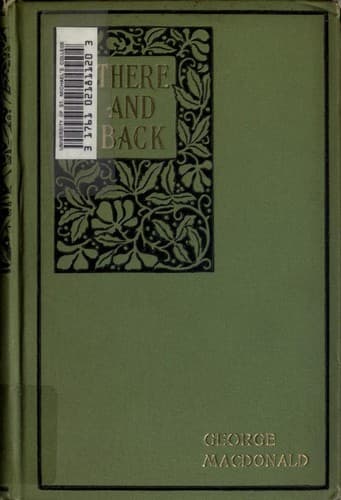
Christian fiction; Wingfold, Thomas (Fictitious character) -- Fiction
cheek was pale and thin, and that his eyes were larger and brighter; she
little thought how the fierce sun of agony had ripened his soul since
they parted.
For the rest of the concert, the music had sunk to a soft delight,
and took the second place; the delight of seeing dulled his delight in
hearing. All the rainbow claspings and weavings of strange accords, all
the wing-wafts of out-dreaming melody, seemed to him to come flickering
and floating from one creative centre--the face, and specially the eyes
of Barbara; yet the music and Barbara seemed one. The form of it that
entered by his eyes met that which entered by his ears, and they were
one ere he noted a difference. Barbara was the music, and the music was
Barbara. He saw her with his ears; he heard her with his eyes. But
as the last sonata sank to its death, suddenly the face and the tones
parted company, and he knew that his eyes and her face must part next,
and the same moment her face was already far away. She had left him; she
was looking for her fan, and preparing to go.
He was not far from the door. He hurried softly out, plunged into the
open air as into a great cool river, went round the house, and took his
stand at one of the doors, where he waited like one watching the flow
of a river of gravel for the shine of a diamond. But the flow sank to
threads and drops, and the diamond never shone.
He walked home, nevertheless, as if he had seen an end of sorrow: how
much had been given him that night, for ever to have and to hold! Such
an hour went far to redeem the hateful thing, life! A much worse world
would be more than endurable, with its black and gray once or twice in
a century crossed by such a band of gold! Who would not plunge through
ages of vapour for one flash of such a star! Who would not dig to the
centre for one glimpse of a gem of such exhaustless fire! “But, alas,
how many for whom no golden threads are woven into the web of life!”
he said to himself as he thought of Alice and Arthur--but straightway
answered himself, saying, “Who dares assert it? The secret of a man's
life is with himself; who can speak for another!” He had himself been
miserable, and was now content--oh, how much more than content--that he
had been miserable! He was even strong to be miserable again! What might
not fall to the lot of the rest, every one of them, ere God, if there
were a God, had done with them! Who invented music? Some one must have
made the delight of it possible! With his own share in its joy he had
had nothing to do! Was Chance its grand inventor, its great ingenieur?
Why or how should Chance love loveliness that was not, and make it be,
that others might love it? Could it be a deaf God, or a being that did
not care and would not listen, that invented music? No; music did not
come of itself, neither could the source of it be devoid of music!
CHAPTER XLV. _THE CARRIAGE_.
Public-domain text, read in full here on John Shaqi.
Reviews
Reviews
No reviews yet
Be the first to share your thoughts on this work.
Elsewhere in the archive
Join the Discussion
Join the discussion
Sign in to leave a comment or review.
Sign InorCreate an account