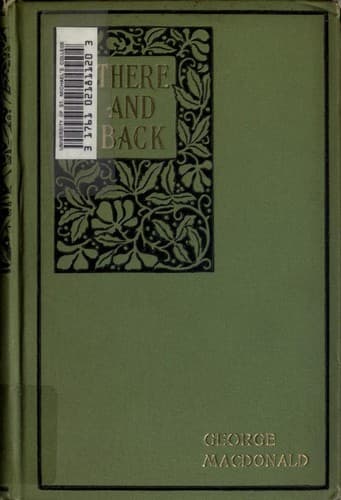
Christian fiction; Wingfold, Thomas (Fictitious character) -- Fiction
But how changed was the world to him since the time that looked so far
away! With how much larger a life in his heart would he now sit in the
orchestra while the gracious forms of music filled the hall, and he
seemed to see them soaring on the pinions of the birds of God, as Dante
calls the angels, or sweeping level in dance divine, like the six-winged
serpents of Isaiah's vision high and lifted up--all the interspaces
filled with glow-worms and little spangled snakes of coruscating sound!
He was more blessed now than even when but to lift his eyes was to see
the face of Barbara; she was in his faith and hope now as well as in his
love. He had the loveliest of letters from her. She insisted he should
not write oftener than once for her twice: his time was worth more,
she said, than twice hers. Mr. Wingfold wrote occasionally, and Richard
always answered within a week.
As soon as his son was gone, sir Wilton began to miss him. He wished,
first, that the obstinacy of the rascal had not made it necessary to
give him quite so sharp a lesson; he wished, next, that he had given him
time to see the reasonableness of his demand; and at length, as the days
and weeks passed, and not a whisper of prayer entered the ears of the
family-Baal, he began to wish that he had not sent him away. The desire
to see him grew a longing; his need of him became imperative. Arthur,
who now tried a little to do the work he had before declined, was
the poorest substitute for Richard; and his father kept thinking how
differently Richard had served him. He repented at last as much as was
possible to him, and wished he had left the rascal to take his own way.
He tried to understand how it was that, anxious always to please him,
he yet would not in such a trifle, and that with nothing to gain and
everything to lose by his obstinacy. There might be conscience in it!
his mother certainly had a conscience! But how could the fool make the
Mansons a matter of _his_ conscience? They were no business of his!
He pretended to himself that he had been born without a conscience. At
the same time he knew very well there were pigeon-holes in his memory he
preferred not searching in; knew very well he had done things which were
wrong, things he knew to be wrong when he did them. If he had ever done
a thing because he ought to do it; if he had ever abstained from doing
a thing because he ought not to do it, he would have _known_ he had
a conscience. Because he did not obey his conscience, he would rather
believe himself without one. I doubt if consciousness ever exists
without conscience, however poorly either may be developed.
Fur the first time in his life he was possessed with a good
longing--namely, for his son; a fulcrum was at length established
which might support leverage for his uplifting. He grew visibly greyer,
stooped more, and became very irritable. Twenty times a day he would be
on the point of sending for Richard, but twenty times a day his pride
checked him.
Public-domain text, read in full here on John Shaqi.
Reviews
Reviews
No reviews yet
Be the first to share your thoughts on this work.
Elsewhere in the archive
Join the Discussion
Join the discussion
Sign in to leave a comment or review.
Sign InorCreate an account