India -- History -- British occupation, 1765-1947; Pamphlets
Produced by Bryan Ness, Martin Pettit and the Online
Distributed Proofreading Team at https://www.pgdp.net (This
file was produced from images generously made available
by The Internet Archive/American Libraries.)
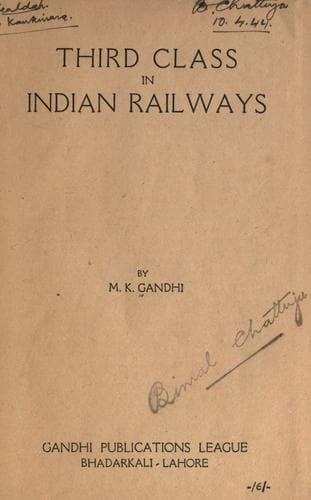
THIRD CLASS IN INDIAN RAILWAYS
BY
M. K. GANDHI
GANDHI PUBLICATIONS LEAGUE
BHADARKALI-LAHORE
THIRD CLASS IN INDIAN RAILWAYS[1]
I have now been in India for over two years and a half after my return
from South Africa. Over one quarter of that time I have passed on the
Indian trains travelling third class by choice. I have travelled up
north as far as Lahore, down south up to Tranquebar, and from Karachi to
Calcutta. Having resorted to third class travelling, among other
reasons, for the purpose of studying the conditions under which this
class of passengers travel, I have naturally made as critical
observations as I could. I have fairly covered the majority of railway
systems during this period. Now and then I have entered into
correspondence with the management of the different railways about the
defects that have come under my notice. But I think that the time has
come when I should invite the press and the public to join in a crusade
against a grievance which has too long remained unredressed, though much
of it is capable of redress without great difficulty.
On the 12th instant I booked at Bombay for Madras by the mail train and
paid Rs. 13-9. It was labelled to carry 22 passengers. These could only
have seating accommodation. There were no bunks in this carriage whereon
passengers could lie with any degree of safety or comfort. There were
two nights to be passed in this train before reaching Madras. If not
more than 22 passengers found their way into my carriage before we
reached Poona, it was because the bolder ones kept the others at bay.
With the exception of two or three insistent passengers, all had to find
their sleep being seated all the time. After reaching Raichur the
pressure became unbearable. The rush of passengers could not be stayed.
The fighters among us found the task almost beyond them. The guards or
other railway servants came in only to push in more passengers.
A defiant Memon merchant protested against this packing of passengers
like sardines. In vain did he say that this was his fifth night on the
train. The guard insulted him and referred him to the management at the
terminus. There were during this night as many as 35 passengers in the
carriage during the greater part of it. Some lay on the floor in the
midst of dirt and some had to keep standing. A free fight was, at one
time, avoided only by the intervention of some of the older passengers
who did not want to add to the discomfort by an exhibition of temper.
On the way passengers got for tea tannin water with filthy sugar and a
whitish looking liquid mis-called milk which gave this water a muddy
appearance. I can vouch for the appearance, but I cite the testimony of
the passengers as to the taste.
Public-domain text, read in full here on John Shaqi.
Reviews
Reviews
No reviews yet
Be the first to share your thoughts on this work.
Join the Discussion
Join the discussion
Sign in to leave a comment or review.
Sign InorCreate an account