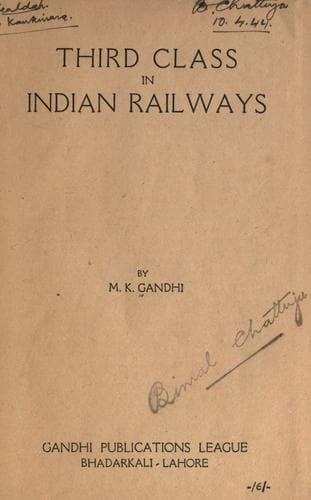
India -- History -- British occupation, 1765-1947; Pamphlets
In its negative form it means not injuring any living being whether by
body or mind. It may not, therefore, hurt the person of any wrong-doer,
or bear any ill-will to him and so cause him mental suffering. This
statement does not cover suffering caused to the wrong-doer by natural
acts of mine which do not proceed from ill-will. It, therefore, does not
prevent me from withdrawing from his presence a child whom he, we shall
imagine, is about to strike. Indeed, the proper practice of Ahimsa
_requires_ me to withdraw the intended victim from the wrong-doer, if I
am, in any way whatsoever, the guardian of such a child. It was,
therefore, most proper for the passive resisters of South Africa to have
resisted the evil that the Union Government sought to do to them. They
bore no ill-will to it. They showed this by helping the Government
whenever it needed their help. _Their resistance consisted of
disobedience of the orders of the Government, even to the extent of
suffering death at their hands._ Ahimsa requires deliberate
self-suffering, not a deliberate injuring of the supposed wrong-doer.
In its positive form, Ahimsa means the largest love, the greatest
charity. If I am a follower of Ahimsa, I _must love_ my enemy. I must
apply the same rules to the wrong-doer who is my enemy or a stranger to
me, as I would to my wrong-doing father or son. This active Ahimsa
necessarily includes truth and fearlessness. As man cannot deceive the
loved one, he does not fear or frighten him or her. Gift of life is the
greatest of all gifts; a man who gives it in reality, disarms all
hostility. He has paved the way for an honourable understanding. And
none who is himself subject to fear can bestow that gift. He must,
therefore, be himself fearless. A man cannot then practice Ahimsa and be
a coward at the same time. The practice of Ahimsa calls forth the
greatest courage. It is the most soldierly of a soldier's virtues.
General Gordon has been represented in a famous statue as bearing only a
stick. This takes us far on the road to Ahimsa. But a soldier, who needs
the protection of even a stick, is to that extent so much the less a
soldier. He is the true soldier who knows how to die and stand his
ground in the midst of a hail of bullets. Such a one was Ambarisha, who
stood his ground without lifting a finger though Duryasa did his worst.
The Moors who were being pounded by the French gunners and who rushed to
the guns' mouths with 'Allah' on their lips, showed much the same type
of courage. Only theirs was the courage of desperation. Ambarisha's was
due to love. Yet the Moorish valour, readiness to die, conquered the
gunners. They frantically waved their hats, ceased firing, and greeted
their erstwhile enemies as comrades. And so the South African passive
resisters in their thousands were ready to die rather than sell their
honour for a little personal ease. This was Ahimsa in its active form.
It _never_ barters away honour. A helpless girl in the hands of a
Public-domain text, read in full here on John Shaqi.
Reviews
Reviews
No reviews yet
Be the first to share your thoughts on this work.
Join the Discussion
Join the discussion
Sign in to leave a comment or review.
Sign InorCreate an account