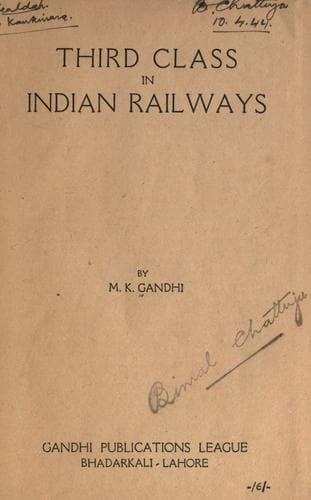
India -- History -- British occupation, 1765-1947; Pamphlets
You will perhaps, therefore,
allow that I have offered the above suggestion not as a biased Hindu,
but as a humble and impartial student of religion with great leanings
towards Christianity. May it not be that "Go ye unto all the world"
message has been somewhat narrowly interpreted and the spirit of it
missed? It will not be denied, I speak from experience, that many of the
conversions are only so-called. In some cases the appeal has gone not to
the heart but to the stomach. And in every case a conversion leaves a
sore behind it which, I venture to think, is avoidable. Quoting again
from experience, a new birth, a change of heart, is perfectly possible
in every one of the great faiths. I know I am now treading upon thin
ice. But I do not apologise in closing this part of my subject, for
saying that the frightful outrage that is just going on in Europe,
perhaps shows that the message of Jesus of Nazareth, the Son of Peace,
had been little understood in Europe, and that light upon it may have to
be thrown from the East.
I have sought your help in religious matters, which it is yours to give
in a special sense. But I make bold to seek it even in political
matters. I do not believe that religion has nothing to do with politics.
The latter divorced from religion is like a corpse only fit to be
buried. As a matter of fact, in your own silent manner, you influence
politics not a little. And I feel that, if the attempt to separate
politics from religion had not been made as it is even now made, they
would not have degenerated as they often appear to have done. No one
considers that the political life of the country is in a happy state.
Following out the Swadeshi spirit, I observe the indigenous institutions
and the village panchayats hold me. India is really a republican
country, and it is because it is that, that it has survived every shock
hitherto delivered. Princes and potentates, whether they were Indian
born or foreigners, have hardly touched the vast masses except for
collecting revenue. The latter in their turn seem to have rendered unto
Caesar what was Caesar's and for the rest have done much as they have
liked. The vast organisation of caste answered not only the religious
wants of the community, but it answered to its political needs. The
villagers managed their internal affairs through the caste system, and
through it they dealt with any oppression from the ruling power or
powers. It is not possible to deny of a nation that was capable of
producing the caste system its wonderful power of organisation. One had
but to attend the great Kumbha Mela at Hardwar last year to know how
skilful that organisation must have been, which without any seeming
effort was able effectively to cater for more than a million pilgrims.
Yet it is the fashion to say that we lack organising ability. This is
true, I fear, to a certain extent, of those who have been nurtured in
the new traditions. We have laboured under a terrible handicap owing to
Public-domain text, read in full here on John Shaqi.
Reviews
Reviews
No reviews yet
Be the first to share your thoughts on this work.
Join the Discussion
Join the discussion
Sign in to leave a comment or review.
Sign InorCreate an account