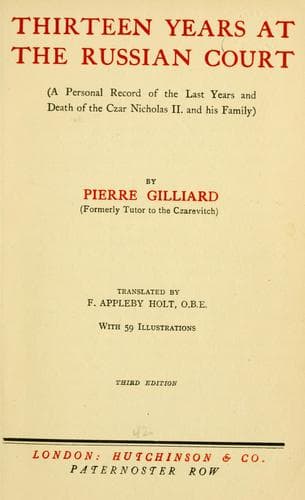
Thirteen years at the Russian court: (a personal record of the last years and death of the Czar Nicholas II. and his family)Gilliard, Pierre
History
Thirteen years at the Russian court: (a personal record of the last years and death of the Czar Nicholas II. and his family)
Gilliard, Pierre
Nicholas II, Emperor of Russia, 1868-1918; Romanov, House of; Soviet Union -- History -- Revolution, 1917-1921 -- Personal narratives
After tea, lessons were resumed until about half-past six. Dinner was an
hour later, after which we went up to the large hall for coffee. We had
all been invited to spend the evening with the family, and this soon
became a regular habit for several of us. Games were organised and
ingenuity shown in finding amusements to break the monotony of our
captivity. When it began to get very cold, and the large hall became
impossible, we took refuge in the adjoining room, which was Their
Majesties’ drawing-room, the only really comfortable apartment in the
house. The Czar would often read aloud while the Grand-Duchesses did
needlework or played with us. The Czarina regularly played one or two
games of bezique with General Tatichtchef and then took up her work or
reclined in her arm-chair. In this atmosphere of family peace we passed
the long winter evenings, lost in the immensity of distant Siberia.
One of the greatest privations during our captivity at Tobolsk was the
almost complete absence of news. Letters only reached us very
irregularly and after long delay. As for newspapers, we were reduced to
a nasty local rag printed on packing paper, which only gave us telegrams
several days old and generally distorted and cut down.
The Czar eagerly followed the development of events in Russia. He
realised that the country was rushing towards ruin. He had a moment of
fresh hope when General Kornilof offered Kerensky to march on Petrograd
to put an end to the Bolshevik agitation, which was becoming more and
more menacing. His disappointment was very great when the Provisional
Government rejected this final chance of salvation. He saw in this the
only means that remained perhaps of avoiding the imminent catastrophe. I
then for the first time heard the Czar regret his abdication. He had
made this decision in the hope that those who had wished to get rid of
him would be capable of making a success of the war and saving Russia.
He had feared that resistance on his part might give rise to a civil
war in the presence of the enemy, and had been unwilling that the blood
of a single Russian should be shed for him. But had not his departure
been almost immediately followed by the appearance of Lenin and his
acolytes, the paid agents of Germany, whose criminal propaganda had
destroyed the army and corrupted the country? It now gave him pain to
see that his renunciation had been in vain, and that by his departure in
the interests of his country he had in reality done her an ill turn.
This idea was to haunt him more and more, and finally gave rise to grave
moral anxiety.
About November 15th we learnt that the Provisional Government was
overthrown and that the Bolsheviks had again come into power. But this
event did not immediately react on our life, and it was not until some
months later, as we shall see, that it occurred to them to turn their
attention to us.
* * * * *
Public-domain text, read in full here on John Shaqi.
Reviews
Reviews
No reviews yet
Be the first to share your thoughts on this work.
Elsewhere in the archive
Join the Discussion
Join the discussion
Sign in to leave a comment or review.
Sign InorCreate an account