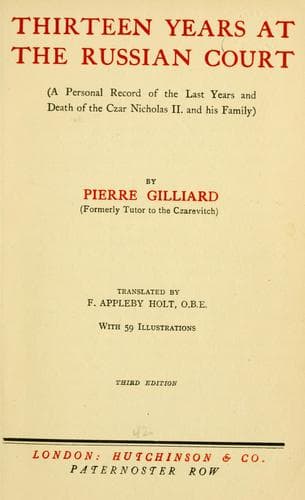
Thirteen years at the Russian court: (a personal record of the last years and death of the Czar Nicholas II. and his family)Gilliard, Pierre
History
Thirteen years at the Russian court: (a personal record of the last years and death of the Czar Nicholas II. and his family)
Gilliard, Pierre
Nicholas II, Emperor of Russia, 1868-1918; Romanov, House of; Soviet Union -- History -- Revolution, 1917-1921 -- Personal narratives
The weeks passed and the news which reached us grew worse and worse. It
was, however, very difficult for us to follow events and grasp their
purport, for the information at our disposal did not allow us to
understand the causes or calculate the consequences; we were, so far, so
isolated from the entire world. And even if we succeeded in getting a
rough knowledge of what was happening in Russia, the rest of Europe was
almost a closed book.
Meanwhile the Bolshevik doctrines had begun their destructive work in
the detachment which was guarding us and which hitherto had been fairly
proof against them. It was composed of very varied elements: the men of
the 1st and 4th Regiments were for the most part favourably disposed
towards the Imperial family, and especially towards the children. The
Grand-Duchesses, with that simplicity which was their charm, loved to
talk to these men, who seemed to them to be linked with the past in the
same way as themselves. They questioned them about their families, their
villages, or the battles in which they had taken part in the great war.
Alexis Nicolaïevitch, who to them was still “the Heir,” had also won
their hearts, and they took trouble to please him and find amusements
for him. One section of the 4th Regiment, composed almost exclusively of
the older classes, was particularly conspicuous in its attachment, and
it was always a delight to the family to see these good fellows come
back on duty. On these days the Czar and children used to go secretly to
the guardhouse and converse or play draughts with the men, whose conduct
was never in a single instance anything but strictly correct. Here they
were once surprised by Commissary Pankratof, who stood astounded on the
doorstep, looking through his spectacles at this unexpected sight. The
Czar, seeing his disconcerted appearance, motioned to him to come and
sit at the table. But the Commissary evidently thought he was out of
place; muttering a few unintelligible words, he turned on his heel and
fled, discomfited.
Pankratof, as I have said, was a fanatic imbued with humanitarian
principles; he was not a bad fellow. Immediately after his arrival he
had organised classes for the soldiers to initiate them in Liberal
doctrines, and did all he could to develop their patriotism and
citizenship. But his efforts recoiled upon himself. A convinced
adversary of the Bolsheviks, he was in reality merely preparing the
ground for them and, without realising it, helping towards the success
of their ideas. As will be seen, he was destined to be the first victim.
Public-domain text, read in full here on John Shaqi.
Reviews
Reviews
No reviews yet
Be the first to share your thoughts on this work.
Elsewhere in the archive
Join the Discussion
Join the discussion
Sign in to leave a comment or review.
Sign InorCreate an account