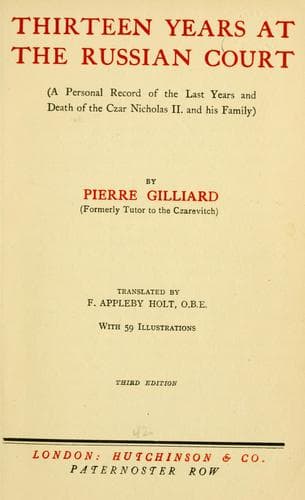
Thirteen years at the Russian court: (a personal record of the last years and death of the Czar Nicholas II. and his family)Gilliard, Pierre
History
Thirteen years at the Russian court: (a personal record of the last years and death of the Czar Nicholas II. and his family)
Gilliard, Pierre
Nicholas II, Emperor of Russia, 1868-1918; Romanov, House of; Soviet Union -- History -- Revolution, 1917-1921 -- Personal narratives
But the hours passed. Our train was shunted back into the station, and
then I saw General Tatichtchef, Countess Hendrikof, and Mlle. Schneider
being taken away. A little later it was the turn of Volkof, the
Czarina’s _valet-de-chambre_, de Kharitonof, the chef, Troup, the
footman, and little Leonide Sednief, a kitchen boy of fourteen.
With the exception of Volkof, who managed to escape later, and little
Sednief, whose life was spared, not one of those who were led off that
day was destined to escape alive from the hands of the Bolsheviks.
We were still kept waiting. What was happening? Why didn’t they come for
us too? We gave ourselves up to all sorts of hypotheses, when, about
five o’clock, Commissary Rodionof, who had come to Tobolsk to fetch us,
entered our carriage and told us we were not wanted and were free.
Free! What was this? We were to be separated from the others? Then all
was over! The excitement that had sustained us up to now gave place to
deep depression. What was to be done? What was to be the next move? We
were overwhelmed.
Even to-day I cannot understand what prompted the Bolsheviks to this
decision to save our lives. Why, for instance, should Countess Hendrikof
be taken to prison while Baroness de Buxhœveden, also a lady-in-waiting
to the Czarina, was allowed to go free? Why they and not ourselves? Was
there confusion of names or functions? A mystery!
On the next and following days I and my colleague went to
[Illustration: IPATIEF’S HOUSE AT EKATERINBURG, IN WHICH THE IMPERIAL
FAMILY WERE INTERNED AND SUBSEQUENTLY MASSACRED.
Seen from the Vosnessensky Prospekt after the first fence had been
erected.
{_Facing page 270._]
see the English and Swedish consuls[70]--the French consul was away; at
all costs something had to be done to help the prisoners. The two
consuls relieved our minds by telling us that proceedings had already
been taken and that they did not think there was any imminent danger.
I walked past Ipatief’s house, of which the tops of the windows could be
seen above the wall of boards that hemmed it in. I had not yet lost all
hope of effecting an entry, for Dr. Derevenko, who had been allowed to
visit the boy, had heard Dr. Botkin ask Commissary Avdief, the
commandant of the guard, on behalf of the Czar, that I should be allowed
to rejoin them. Avdief had replied that he would refer the matter to
Moscow. Meanwhile, my companions and I, except Dr. Derevenko, who had
taken lodgings in the town, camped in the fourth-class carriage which
had brought us. We were destined to remain there for more than a month!
Public-domain text, read in full here on John Shaqi.
Reviews
Reviews
No reviews yet
Be the first to share your thoughts on this work.
Elsewhere in the archive
Join the Discussion
Join the discussion
Sign in to leave a comment or review.
Sign InorCreate an account