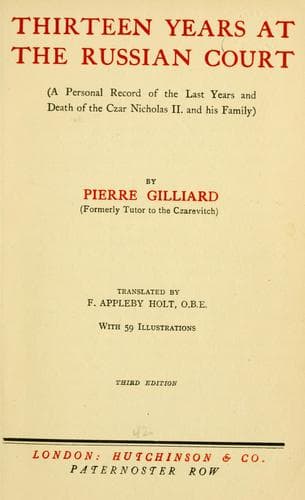
Thirteen years at the Russian court: (a personal record of the last years and death of the Czar Nicholas II. and his family)Gilliard, Pierre
History
Thirteen years at the Russian court: (a personal record of the last years and death of the Czar Nicholas II. and his family)
Gilliard, Pierre
Nicholas II, Emperor of Russia, 1868-1918; Romanov, House of; Soviet Union -- History -- Revolution, 1917-1921 -- Personal narratives
On the twenty-sixth we were ordered to leave the territory of the Perm
Government--which includes Ekaterinburg--without delay and return to
Tobolsk. Care had been taken that we should only have one document
between us, to keep us together and so facilitate supervision. But the
trains were no longer running. The anti-Bolshevik movement of the
Russian and Czech volunteers[71] was spreading rapidly, and the line
was exclusively reserved for the military units that were being hurried
to Tioumen. This meant further delay.
One day when I was passing Ipatief’s house, accompanied by Dr. Derevenko
and Mr. Gibbes, we saw two carriages drawn up and surrounded by a large
number of Red Guards. What was our horror at recognising in the first
Sednief (the _valet-de-chambre_ of the Grand-Duchesses) sitting between
two guards. Nagorny was going to the second carriage. He was just
setting foot on the step with his hand on the side of the carriage when,
raising his head, he saw us all there standing motionless a few yards
from him. For a few seconds he looked fixedly at us, then, without a
single gesture that might have betrayed us, he took his seat. The
carriages were driven off, and we saw them turn in the direction of the
prison.
These two good fellows were shot shortly afterwards; their sole crime
had been their inability to hide their indignation on seeing the
Bolshevik commissaries seize the little gold chain from which the holy
images hung over the sick bed of Alexis Nicolaïevitch.
A few more days passed, and then I learned through Dr. Derevenko that
the request made on my behalf had been refused.
On June 3rd our carriage was coupled to one of the many trains loaded
with starving people from Russia coming to look for food in Siberia. We
made for Tioumen, where, after various wanderings, we finally arrived on
the fifteenth. A few hours later I was placed under arrest by Bolshevik
headquarters, where I had been forced to apply for a _visa_ that was
indispensable to my companions and myself. It was only by a lucky
combination of circumstances that I came to be released in the evening
and was able to get back to the railway carriage, in
[Illustration: YOUROVSKY, FROM A PHOTOGRAPH PRODUCED AT THE ENQUIRY.]
[Illustration: THE GRAND-DUCHESSES’ ROOM AS I SAW IT ON ENTERING
IPATIEF’S HOUSE. ON THE FLOOR ARE THE ASHES FROM THE STOVES.
{_Facing page 272._]
which they were waiting for me. The following days were days of
indescribable anxiety, at the mercy of any chance that might call
attention to us. Probably what saved us was that we were lost in the
crowd of refugees who filled Tioumen station, and so managed to pass
unnoticed.
* * * * *
Public-domain text, read in full here on John Shaqi.
Reviews
Reviews
No reviews yet
Be the first to share your thoughts on this work.
Elsewhere in the archive
Join the Discussion
Join the discussion
Sign in to leave a comment or review.
Sign InorCreate an account