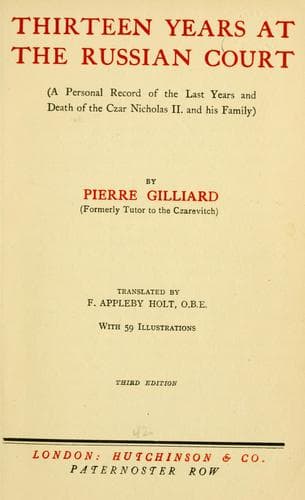
Thirteen years at the Russian court: (a personal record of the last years and death of the Czar Nicholas II. and his family)Gilliard, Pierre
History
Thirteen years at the Russian court: (a personal record of the last years and death of the Czar Nicholas II. and his family)
Gilliard, Pierre
Nicholas II, Emperor of Russia, 1868-1918; Romanov, House of; Soviet Union -- History -- Revolution, 1917-1921 -- Personal narratives
I became convinced that the Czar had perished and, granting that, I
could not believe that the Czarina had survived him. At Tobolsk, when
Commissary Yakovlef had come to take away the Czar, I had seen her throw
herself in where the danger seemed to her greatest. I had seen her,
broken-hearted after hours of mental torture, torn desperately between
her feelings as a wife and a mother, abandon her sick boy to follow the
husband whose life seemed in danger. Yes, it was possible they might
have died together, the victims of these brutes. But the children? They
too massacred? I could not believe it. My whole being revolted at the
idea. And yet everything proved that there had been many victims. Well,
then?...
During the following days I continued my investigations in Ekaterinburg
and its suburbs--the monastery, everywhere I could hope to find the
slightest clue. I saw Father Storojef, who had been the last to conduct
religious service in Ipatief’s house, on Sunday, the 14th, two days
before the night of terror. He too, alas, had very little hope.
The enquiry proceeded very slowly. It was begun in extremely difficult
circumstances, for, between July 17th and 25th the Bolshevik
commissaries had had time to efface nearly every trace of their crime.
Immediately after the taking of Ekaterinburg by the Whites, the military
authorities had surrounded the house with a guard and a judicial enquiry
had been opened, but the threads had been so skilfully entangled that it
was very difficult to sort them out.
The most important deposition was that of some peasants from the village
of Koptiaki, twenty versts north-west of Ekaterinburg. They came to give
evidence that on the night of July 16th-17th the Bolsheviks had occupied
a clearing in a forest near their village, where they had remained
several days. They brought with them objects which they had found near
the shaft of an abandoned mine, not far from which could be seen traces
of a large fire. Some officers visited the clearing and found other
objects, which, like the first, were recognised as having belonged to
the Imperial family.
The enquiry had been entrusted to Ivan Alexandrovitch Serguéief, a
member of the Ekaterinburg tribunal. It followed a normal course, but
the difficulties were very great. Serguéief was more and more inclined
to admit the death of all the members of the family. But the bodies
could still not be found, and the depositions of a certain number of
witnesses supported the hypothesis that the Czarina and the children had
been removed to another place. These depositions--as was subsequently
established--emanated from Bolshevik agents deliberately left in
Ekaterinburg to mislead the enquiry. Their end was partially attained,
for Serguéief lost precious time and was long in realising that he was
on the wrong track.
Public-domain text, read in full here on John Shaqi.
Reviews
Reviews
No reviews yet
Be the first to share your thoughts on this work.
Elsewhere in the archive
Join the Discussion
Join the discussion
Sign in to leave a comment or review.
Sign InorCreate an account