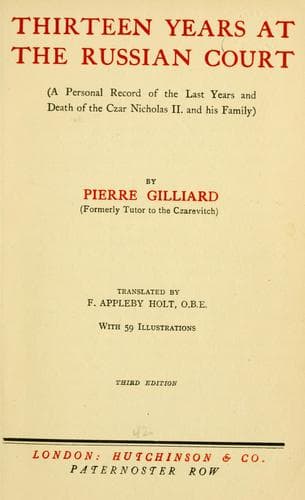
Thirteen years at the Russian court: (a personal record of the last years and death of the Czar Nicholas II. and his family)Gilliard, Pierre
History
Thirteen years at the Russian court: (a personal record of the last years and death of the Czar Nicholas II. and his family)
Gilliard, Pierre
Nicholas II, Emperor of Russia, 1868-1918; Romanov, House of; Soviet Union -- History -- Revolution, 1917-1921 -- Personal narratives
On July 20th the Whites, as the anti-Bolshevik troops were called,
captured Tioumen and saved us from the fanatics who had so nearly
claimed us as victims. A few days later the papers published a
reproduction of the proclamation that had been placarded in the streets
of Ekaterinburg, announcing that the sentence of death passed on the
ex-Czar Nicholas Romanoff had been carried out on the night of July
16th-17th and that the Czarina and her children had been removed to a
place of safety.
At last, on July 25th, Ekaterinburg fell in its turn. Hardly was
communication re-established--which took a long time as the permanent
way had suffered severely--when Mr. Gibbes and I hastened to the town to
search for the Imperial family and those of our companions who had
remained at Ekaterinburg.
Two days after my arrival I made my first entry into Ipatief’s house. I
went through the first-floor rooms, which had served as the prison; they
were in an indescribable state of disorder. It was evident that every
effort had been made to get rid of any traces of the recent occupants.
Heaps of ashes had been raked out of the stoves. Among them were a
quantity of small articles, half burnt, such as tooth-brushes, hairpins,
buttons, etc., in the midst of which I found the end of a hair-brush on
the browned ivory of which could still be seen the initials of the
Czarina, A. F. (Alexandra-Feodorovna.). If it was true that the
prisoners had been sent away, they must have been removed just as they
were, without any of the most essential articles of toilet.
I then noticed on the wall in the embrasure of one of the windows of
Their Majesties’ room the Empress’s favourite charm, the swastika,[72]
which she had put up everywhere to ward off ill-luck. She had drawn it
in pencil, and added, underneath, the date, 17/30 April, the day of
their incarceration in the house. The same symbol, but without the date,
was drawn on the wallpaper, on a level with the bed, occupied doubtless
by her or Alexis Nicolaïevitch. But my search was to no purpose, I could
not find the slightest clue to their fate.
I went down to the bottom floor, the greater part of which was below the
level of the ground. It was with intense emotion that I entered the room
in which perhaps--I was still in doubt--they had met their death. Its
appearance was sinister beyond expression. The only light filtered
through a barred window at the height of a man’s head. The walls and
floor showed numerous traces of bullets and bayonet scars. The first
glance showed that an odious crime had been perpetrated there and that
several people had been done to death. But who? How?
Public-domain text, read in full here on John Shaqi.
Reviews
Reviews
No reviews yet
Be the first to share your thoughts on this work.
Elsewhere in the archive
Join the Discussion
Join the discussion
Sign in to leave a comment or review.
Sign InorCreate an account