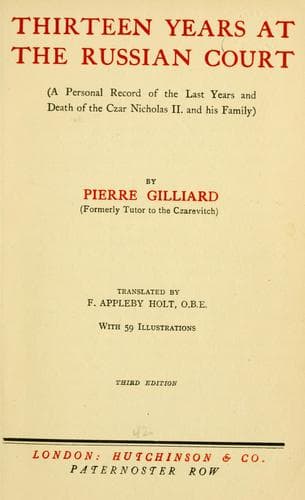
Thirteen years at the Russian court: (a personal record of the last years and death of the Czar Nicholas II. and his family)Gilliard, Pierre
History
Thirteen years at the Russian court: (a personal record of the last years and death of the Czar Nicholas II. and his family)
Gilliard, Pierre
Nicholas II, Emperor of Russia, 1868-1918; Romanov, House of; Soviet Union -- History -- Revolution, 1917-1921 -- Personal narratives
The wait is prolonged. Suddenly Yourovsky re-enters the room with seven
Austro-Germans and two of his friends, Commissaries Ermakof and Vaganof,
accredited executioners of the _Tchrezvytchaïka_. Medvedief is also
present. Yourovsky comes forward and says to the Czar: “Your men have
tried to save you but haven’t succeeded, and we are forced to put you to
death.” He immediately raises his revolver and fires point-blank at the
Czar, who falls dead. This is the signal for a general discharge of
revolvers. Each of the murderers has chosen his victim. Yourovsky has
reserved for himself the Czar and Czarevitch. For most of the prisoners
death is instantaneous. But Alexis Nicolaïevitch is moaning feebly.
Yourovsky finishes him off with a shot from his revolver. Anastasie
Nicolaïevna is only wounded, and begins to scream as the murderers
approach; she is killed by their bayonets. Anna Demidova, too, has been
spared, thanks to the cushions which she holds in front of her. She
rushes about, and finally falls under the bayonets of the assassins.
The depositions of the witnesses have made it possible for the enquiry
to reconstruct the ghastly scene of the massacre in all its details.
These witnesses are Paul Medvedief,[76] one of the murderers; Anatole
Yakimof, who was certainly present at the drama, although he denies it,
and Philip Proskouriakof, who describes the crime from the story of
other spectators. All three were members of the guard at Ipatief’s
house.
* * * * *
When all is over, the commissaries remove from the victims their jewels,
and the bodies are carried, with the help of sheets and the shafts of a
sledge, to a motor-wagon which is waiting at the courtyard door, between
the two wooden fences.
They have to hurry for fear of the dawn. The funeral procession crosses
the still-sleeping town and makes for the forest. Commissary Vaganof
rides ahead, as a chance encounter must be avoided. Just as they are
approaching the clearing for which they are making, he sees a wagon
driven by peasants coming towards him. It is a woman of the village of
Koptiaki, who set out in the night with her son and daughter-in-law to
sell fish in the town. He orders them to turn round and go home. To make
doubly sure he goes with them, galloping alongside the cart, and forbids
them under pain of death to turn round or look behind them. But the
peasant woman has had time to catch a glimpse of the great dark object
coming up behind the horseman. When she gets back to the village she
tells what she has seen. The puzzled peasants start out to reconnoitre,
and run into a cordon of sentries stationed in the forest.
Public-domain text, read in full here on John Shaqi.
Reviews
Reviews
No reviews yet
Be the first to share your thoughts on this work.
Elsewhere in the archive
Join the Discussion
Join the discussion
Sign in to leave a comment or review.
Sign InorCreate an account