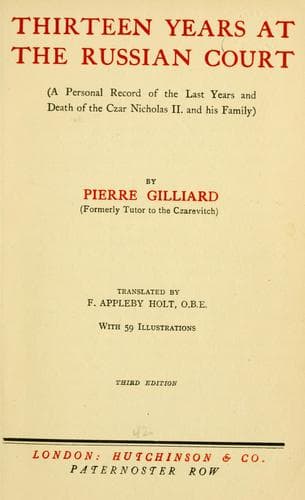
Thirteen years at the Russian court: (a personal record of the last years and death of the Czar Nicholas II. and his family)Gilliard, Pierre
History
Thirteen years at the Russian court: (a personal record of the last years and death of the Czar Nicholas II. and his family)
Gilliard, Pierre
Nicholas II, Emperor of Russia, 1868-1918; Romanov, House of; Soviet Union -- History -- Revolution, 1917-1921 -- Personal narratives
However, after great difficulties, for the roads are very bad, the
motor-wagon reaches the clearing. The bodies are placed on the ground
and partly undressed. It is then that-the commissaries discover a
quantity of jewellery that the Grand-Duchesses carry concealed under
their clothes. They at once seize them, but, in their haste, let a few
fall on the ground, where they are trodden into the soil. The bodies are
then cut in pieces and placed on great bonfires, which are made to burn
more fiercely by the application of benzine. The parts which resist the
flames are destroyed with sulphuric acid. For three days and three
nights the murderers toil at their labour of destruction under the
direction of Yourovsky and his two friends Ermakof and Vaganof. One
hundred and seventy-five kilogrammes of sulphuric acid and more than 300
litres of benzine are brought to the clearing.
At last, on July 20th, all is finished. The murderers efface all traces
of the fires, and the ashes are thrown into a mine-shaft or scattered
about the neighbourhood of the clearing, so that nothing may reveal what
has taken place.
* * * * *
Why did these men take so much trouble to efface all traces of their
deed? Why, since they professed to be acting as the servants of justice,
did they hide like criminals? And from whom were they hiding?
It is Paul Medvedief who explains this in his evidence. After the crime
Yourovsky came up to him and said, “Keep the outside sentries at their
posts in case there is trouble with the people!” And during the
following days the sentries continued to mount guard round the empty
house as if nothing had happened, as if the fences still shut in the
prisoners.
[Illustration: M. SOKOLOFF EXAMINING THE ASHES OF THE FIRE NEAREST TO
THE MINE-SHAFT.]
[Illustration: M. SOKOLOFF EXAMINING THE TRACES OF ONE OF THE FIRES AT
THE FOOT OF AN OLD PINE.
{_Facing page 290._]
Those who must be deceived, must not know, are the _Russian people_.
Another fact proves this: the precaution taken on July 4th of sending
away Avdief and the Russian guard. The commissaries no longer had
confidence in these workmen from the Sissert workshops and the factory
of Zlokazof, who had, however, rallied to their cause and enlisted
voluntarily to guard “bloody Nicholas.” They knew that none but paid
assassins, convicts, or foreigners would consent to carry through the
infamous task they were proposing. These assassins were Yourovsky (a
Jew), Medvedief, Nikouline, Ermakof, Vaganof, Russian convicts, and
seven Austro-Germans.
Yes, it was from the Russian people that they were hiding, the men whose
agents they professed to be. It was of them they were afraid; of their
vengeance.
* * * * *
At last, on July 20th, they decided to speak and announce the death of
the Emperor to the people in a proclamation published in the following
form:
DECISION
Public-domain text, read in full here on John Shaqi.
Reviews
Reviews
No reviews yet
Be the first to share your thoughts on this work.
Elsewhere in the archive
Join the Discussion
Join the discussion
Sign in to leave a comment or review.
Sign InorCreate an account