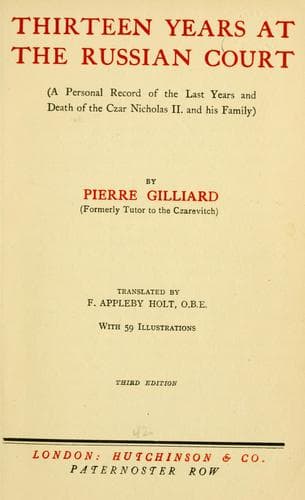
Thirteen years at the Russian court: (a personal record of the last years and death of the Czar Nicholas II. and his family)Gilliard, Pierre
History
Thirteen years at the Russian court: (a personal record of the last years and death of the Czar Nicholas II. and his family)
Gilliard, Pierre
Nicholas II, Emperor of Russia, 1868-1918; Romanov, House of; Soviet Union -- History -- Revolution, 1917-1921 -- Personal narratives
As for Nagorny, Alexis Nicolaïevitch’s sailor, and the footman, Ivan
Sednief, they were put to death in the neighbourhood of Ekaterinburg in
the beginning of June, 1918. Their bodies were found two months later at
the place of execution.
All, from General to seaman, did not hesitate to sacrifice their lives
and go bravely to meet death. This seaman, however, a humble peasant
from the Ukraine, had only to say one word to be saved. He had only to
deny his Czar. This word remained unspoken.
For a long time, with simple and sincere faith, they had devoted their
lives to those they loved, who had been able to inspire those who
surrounded them with so much affection, courage, and self-sacrifice.
EPILOGUE
The summer of 1919 was marked by the great reverses which were to bring,
a few months later, the downfall of Admiral Koltchak’s government. The
Bolshevik troops had retaken Perm and were threatening Ekaterinburg. The
work undertaken in the clearing at Koptiaki had to be abandoned before
its completion. On July 12th, N. Sokolof, heart-broken, decided to leave
for Omsk. There he spent the month of August, and then, seeing that the
situation was growing still worse, he went on to Tchita, whilst I
remained at Omsk.
A few weeks after his departure, two Russian officers came to the French
Military Mission and asked to speak to me. They told me that General
D---- had an important communication to make to me, and begged me to be
so kind as to go and see him. We got into the car which was waiting, and
a few moments later I found myself in his presence.
General D---- informed me that he wanted to show me a boy who claimed to
be the Czarevitch. I knew in fact that a rumour was spreading in Omsk
that the Czarevitch was still alive. He was announced to be in a small
town of Altaï. I had been told that the inhabitants had greeted him with
enthusiasm, the schoolchildren had made a collection on his behalf, and
the governor of the station had offered him, on his knees, bread and
salt. In addition, Admiral Koltchak had received a telegram asking him
to come to the assistance of the pretended Czarevitch. I had paid no
attention to these stories.
Fearing that these circumstances might give rise to difficulties, the
Admiral had had the “Pretender” brought to Omsk; and General D---- had
called for me, thinking that my evidence would settle the difficulty and
put a stop to the legend that was beginning to grow up.
The door of the next room was opened a little, and I was able to
observe, unknown to him, a boy, taller and stronger than the Czarevitch,
who seemed to me fifteen or sixteen years old. His sailor’s costume, the
colour of his hair, and the way it was arranged were vaguely reminiscent
of Alexis Nicolaïevitch. There the resemblance ended.
Public-domain text, read in full here on John Shaqi.
Reviews
Reviews
No reviews yet
Be the first to share your thoughts on this work.
Elsewhere in the archive
Join the Discussion
Join the discussion
Sign in to leave a comment or review.
Sign InorCreate an account