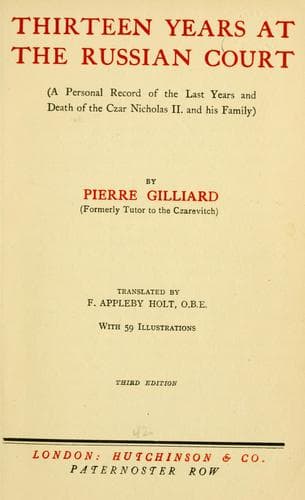
Thirteen years at the Russian court: (a personal record of the last years and death of the Czar Nicholas II. and his family)Gilliard, Pierre
History
Thirteen years at the Russian court: (a personal record of the last years and death of the Czar Nicholas II. and his family)
Gilliard, Pierre
Nicholas II, Emperor of Russia, 1868-1918; Romanov, House of; Soviet Union -- History -- Revolution, 1917-1921 -- Personal narratives
I told General D---- the result of my observations. The boy was
introduced to me. I put several questions to him in French: he remained
dumb. When a reply was insisted upon he said that he understood
everything I had said but had his own reasons for only speaking Russian.
I then addressed him in that language. This, too, brought no results. He
said he had decided to answer no one but Admiral Koltchak himself. So
our interview ended.[77]
Chance had brought across my path the first of the countless pretenders
who doubtless for many years to come will be a source of trouble and
agitation among the ignorant and credulous masses of the Russian
peasantry.
* * * * *
In March, 1920, I rejoined General Ditériks and N. Sokolof at Kharbine,
whither they had drifted, like myself, after the collapse of Admiral
Koltchak’s government. They were in a state of great agitation, for the
situation in Manchuria was growing daily more precarious, and it was
expected that at any moment the Chinese eastern railway might fall into
the hands of the Reds. Bolshevik spies were already beginning to swarm
over the station and its surroundings. What was to be done with the
documents of the enquiry? Where could they be put in safety? General
Ditériks and N. Sokolof had appealed to the British High Commissioner
before his departure for Pekin, asking him to take to Europe the relics
of the Imperial family and the evidence of the enquiry. He had asked for
instructions from his Government. The reply was a long time coming. It
came at last.... It was in the negative!
I then appealed personally to General Janin, informing him of the
situation.[78]
“I am quite ready to help you,” he told me. “I can do it on my own
responsibility, as there is not time to refer the matter to my
Government. But it shall not be said that a French General refused the
relics of one who was the faithful ally of France. Ask General Ditériks
to furnish me with a written request expressing his certainty of my
consent; I should consider doubt as a reflection on me.”
The letter was sent, and General Ditériks came to an understanding with
General Janin as to the arrangements for transmitting the precious
objects to the person named by him in Europe.
Two days later, General Ditériks, his two orderly officers, N. Sokolof,
and myself took on our shoulders the heavy valises prepared beforehand
and carried them to General Janin’s train, which was standing a short
distance from the station. In single file we were approaching the
platform when those in the rear suddenly saw several figures start up
out of the shadows and accost us, shouting: “Where are you going? What
have you got in those bags?” As we hurried on without reply they made as
if to stop us and ordered us to open our valises. The distance that
remained was fortunately not very great; we dashed forward at full
speed, and a moment later reached the General’s carriage, the sentries
having already run up to meet us.
Public-domain text, read in full here on John Shaqi.
Reviews
Reviews
No reviews yet
Be the first to share your thoughts on this work.
Elsewhere in the archive
Join the Discussion
Join the discussion
Sign in to leave a comment or review.
Sign InorCreate an account