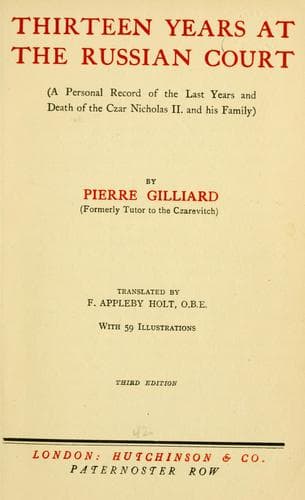
Thirteen years at the Russian court: (a personal record of the last years and death of the Czar Nicholas II. and his family)Gilliard, Pierre
History
Thirteen years at the Russian court: (a personal record of the last years and death of the Czar Nicholas II. and his family)
Gilliard, Pierre
Nicholas II, Emperor of Russia, 1868-1918; Romanov, House of; Soviet Union -- History -- Revolution, 1917-1921 -- Personal narratives
The Czar and Czarina died believing themselves martyrs to their country:
they have died martyrs to humanity. Their real greatness is not to be
measured by the prestige of their Imperial dignity, but by the wonderful
moral heights to which they gradually attained. They have become a
force, an ideal; and in the very outrage they have suffered we find a
touching testimony to that wonderful serenity of soul against which
violence and passion can avail nothing and which triumphs unto death.
THE END
PRINTED BY THE ANCHOR PRESS, LTD., TIPTREE, ESSEX, ENGLAND
FOOTNOTES:
[1] To give some idea of what I mean, it is only necessary to record
that in one of these books (which is based on the evidence of an
_eyewitness_ of the drama of Ekaterinburg, the authenticity of which is
guaranteed) there is a description of my death! All the rest is on a
par.
Everyone desiring information about the end of the reign of Nicholas
II. should read the remarkable articles recently published in the
_Revue des Deux Mondes_ by M. Paleologue, the French Ambassador at
Petrograd.
[2] It was in 1909 that my duties as tutor to Duke Sergius of
Leuchtenberg came to an end. I had thus more time for my duties at the
Court.
[3] An Imperial sporting estate in the Government of Grodno. This
forest and the Caucasus are the only places where the aurochs, or
European bison, is found. They still rove these immense forests, which
occupy an area of more than three thousand acres.
[4] An ancient hunting-seat of the kings of Poland.
[5] He was generally carried by Derevenko, formerly a sailor on the
Imperial yacht _Standard_, to whom this duty had been assigned several
years before.
[6] He had the same surname as Derevenko, the sailor whom I have
mentioned above. A constant cause of confusion.
[7] About 85 per cent. of bleeders die in their childhood or early
youth. The chances of a fatal issue diminish greatly as they attain
manhood. That is easily understood. An adult knows how to exercise the
care his condition requires, and the causes of trauma are thus greatly
lessened. Although hæmophilia is incurable, it does not prevent many of
its victims from reaching an advanced old age. The children of Alexis
Nicolaïevitch would not have been affected by this terrible malady, as
it is only transmitted by women.
[8] Queen Victoria did not like the Germans and had a particular
aversion for the Emperor William II., which she handed on to her
granddaughter, who always preferred England, her country on her
mother’s side, to Germany. Yet she always remained greatly attached to
the friends and relations she had left there.
[9] She was extremely anxious to improve the lot of poor women by
building maternity and other hospitals. She hoped to establish
professional schools, and so on.
[10] Her continual fear of an attempt on the life of the Czar or her
son always helped to wear down the Czarina’s nervous vitality.
Public-domain text, read in full here on John Shaqi.
Reviews
Reviews
No reviews yet
Be the first to share your thoughts on this work.
Elsewhere in the archive
Join the Discussion
Join the discussion
Sign in to leave a comment or review.
Sign InorCreate an account