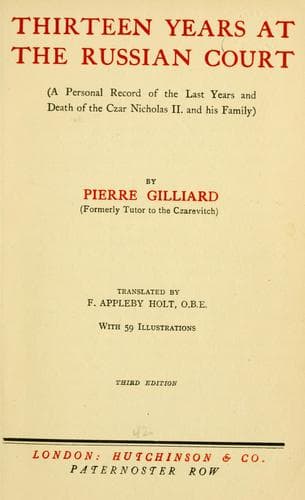
Thirteen years at the Russian court: (a personal record of the last years and death of the Czar Nicholas II. and his family)Gilliard, Pierre
History
Thirteen years at the Russian court: (a personal record of the last years and death of the Czar Nicholas II. and his family)
Gilliard, Pierre
Nicholas II, Emperor of Russia, 1868-1918; Romanov, House of; Soviet Union -- History -- Revolution, 1917-1921 -- Personal narratives
At last all the evidence was in safety. It was time, for, as had just
been proved, we were marked down. An hour later we slipped out of the
train one after the other and made our way unobserved between the
carriages of others standing near.
On the next day General Ditériks brought General Janin the box
containing the relics of the Imperial family.
This happened on March 19th, 1920.
* * * * *
There was nothing now to keep me in Siberia. I felt that I had fulfilled
the last duty towards those to whom I was attached by such poignant
memories. More than two years had passed since I had been separated from
them at Ekaterinburg.
Ekaterinburg! As I was leaving Russia, with what emotion I lived again,
down to the least details, the painful scenes which this name called up
in my mind! Ekaterinburg to me meant the despair of feeling my every
effort vain; cruel and brutal separation; for them it was to be the last
stage of their long Calvary, two months of suffering to be endured
before the supreme deliverance.
It was the period when Germany was determined to triumph at any price
and believed that victory was at last within her grasp; and while
William fraternised with Lenin, his armies were making one more thrust
at Paris.
In this total collapse of Russia there were still two points of
resistance; in this abysmal night two fires remained where the flame of
faith still burned bright. There was, on the one hand, General
Alexeief’s gallant little army of volunteers, struggling desperately
against the Soviet regiments stiffened by German officers. On the other,
behind the wooden enclosures which imprisoned him, the Czar, too, was
leading his last fight. Supported by the Czarina, he had refused all
compromise. Nothing remained but to sacrifice their lives; they were
ready to do this rather than bargain with the enemy who had ruined their
country by violating its honour.
And death came, but death refused to separate those whom life had so
closely bound together, and it took them all seven, united in one faith
and one love.
I feel that events have spoken for themselves. Anything I might be able
to add now--intensely as my feelings have been quickened by recalling
those days of anguish relived sometimes from hour to hour--would appear
mere vain literature and misplaced sentimentality compared with the
poignant significance of the facts.
I must, however, assert here this conviction: it is impossible that
those of whom I have spoken should have suffered their martyrdom in
vain. I know not when it will be, nor how; but one day or other, without
any doubt, when brutality has bled itself to death in the excess of its
fury, humanity will draw from the memory of their sufferings an
invincible force for moral reparation.
Whatever revolt may rankle in the heart, and however just vengeance may
be, to hope for an expiation in blood would be an insult to their
memory.
Public-domain text, read in full here on John Shaqi.
Reviews
Reviews
No reviews yet
Be the first to share your thoughts on this work.
Elsewhere in the archive
Join the Discussion
Join the discussion
Sign in to leave a comment or review.
Sign InorCreate an account