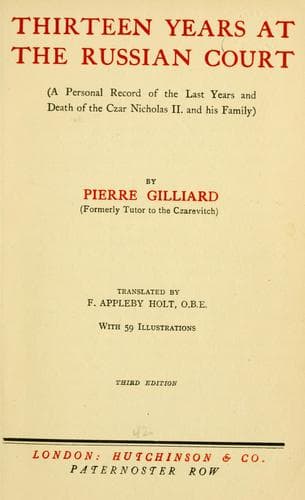
Thirteen years at the Russian court: (a personal record of the last years and death of the Czar Nicholas II. and his family)Gilliard, Pierre
History
Thirteen years at the Russian court: (a personal record of the last years and death of the Czar Nicholas II. and his family)
Gilliard, Pierre
Nicholas II, Emperor of Russia, 1868-1918; Romanov, House of; Soviet Union -- History -- Revolution, 1917-1921 -- Personal narratives
[26] The Czar used to say that diplomacy is the art of making white
appear black. _Apropos_ of this subject, he once quoted me Bismarck’s
definition of an ambassador, “A man sent to another country to tell
lies for the benefit of his own,” and he added: “Thank Heaven they’re
not all trained in _his_ school, but diplomats have a gift for
complicating the most simple questions.”
[27] Austria delayed the issue of the ultimatum until it was a
practical impossibility for news of it to reach St. Petersburg before
M. Poincaré left.
[28] In the winter of 1918, when I was at Tioumen, I saw copies of
these very telegrams. Later on I found it impossible to get hold of the
text again.
[29] The German General Staff knew only too well that in view of the
extreme complexity of the Russian mobilisation (the immense size of
the country, the poor railways, etc.), it could not be countermanded
without such a disorganisation of the services as would prevent it
being resumed for three weeks. A start of three weeks for Germany meant
certain victory.
[30] I had these details from the Grand-Duchess Anastasie Nicolaïevna,
who described the scene to me next morning.
[31] Alexis Nicolaïevitch had not recovered from his accident when he
made his condition worse by an imprudent act. He was thus unable to
accompany his parents to St. Petersburg--a great blow to them.
[32] I cannot say that the Czarina had any personal affection for
France, a country with which she had no ties and no particular
temperamental affinity. She did not understand the French mind,
and took all the literary acrobatics of our “_immoralistes_” quite
seriously. On the other hand, she thoroughly enjoyed the great
nineteenth-century poets.
[33] He was the grandson of the Czar Nicholas I., and had been
appointed Generalissimo of the Russian armies immediately after the
declaration of war.
[34] This is the gate by which the Czars always entered to go to the
Kremlin when they visited Moscow. It leads from the city to the Red
Square, which lies against the eastern wall of the Kremlin.
[35] In the 39 Governments of Russia the executive authorities were
assisted by the provincial assemblies (_zemstvos_), who looked after
the economic interests of the Government, the establishment of schools,
hospitals, etc. There were also district _zemstvos_ in the same
Governments.
[36] Madame Wyroubova survived her injuries, but her convalescence was
a very long and dreary process and she was always a cripple after her
accident.
[37] By a ukase of August 31st, 1914, the Czar had decreed that St.
Petersburg should henceforth be called Petrograd.
[38] It was the same sentiment which made him say to an officer of
his suite after his abdication: “Just to think that, now I am Czar no
longer, they won’t even let me fight for my country!” The words reveal
the very depths of his soul.
Public-domain text, read in full here on John Shaqi.
Reviews
Reviews
No reviews yet
Be the first to share your thoughts on this work.
Elsewhere in the archive
Join the Discussion
Join the discussion
Sign in to leave a comment or review.
Sign InorCreate an account