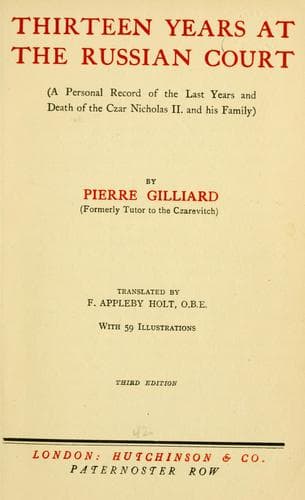
Thirteen years at the Russian court: (a personal record of the last years and death of the Czar Nicholas II. and his family)Gilliard, Pierre
History
Thirteen years at the Russian court: (a personal record of the last years and death of the Czar Nicholas II. and his family)
Gilliard, Pierre
Nicholas II, Emperor of Russia, 1868-1918; Romanov, House of; Soviet Union -- History -- Revolution, 1917-1921 -- Personal narratives
[39] The French army in its march on Moscow occupied Mohileff on July
19th, and Marshal Davout lived for several days in the same house which
the Czar and Czarevitch had made their quarters.
[40] Professor Fiodrof accompanied the Czar on all his journeys after
the latter took over the supreme command. Dr. Botkin and Dr. Derevenko
had remained behind at Tsarskoïe-Selo.
[41] I should like to record a slight incident at the beginning of
spring when the Czar was at Tsarskoïe-Selo between his visits to the
front. It illustrates the kind of feelings the Czar entertained for
Germany and tried to instil into his son. The Czarevitch was playing
in the park that day, and the Czar and the Grand-Duchesses were also
there. He slipped behind his youngest sister, who had not seen him
coming, and threw a huge snowball at her. His father had witnessed the
act. He called the boy to him and talked to him severely. “You ought
to be ashamed of yourself, Alexis! You’re behaving like a German, to
attack anyone from behind when they can’t defend themselves. It’s
horrid and cowardly. Leave that sort of behaviour to the Germans!”
[42] I was able to ascertain this for myself at the end of 1915. At the
house of some friends one day I met a young officer whose political
opinions were favourable to the Court. He told us with intense
indignation that on the Czarina’s orders someone had taken gifts and
money to the German officers being treated at the same hospital as he
had been in. This envoy had not even entered the rooms occupied by the
Russian officers. Astonished at his story, I asked for details. An
enquiry was ordered. It completely confirmed the story I had been told,
but it was impossible to trace the individual who had succeeded, by
the use of forged papers, in making the authorities believe he had an
official mission. Pure chance had brought me into contact with one of
the many provocations organised by German spies with German money.
[43] At the time I am writing I find what I have said fully confirmed
in the following passage from an article by M. Paleologue, French
Ambassador at Petrograd: _La Russie des Tsars pendant la Grande Guerre_
(_Revue des Deux Mondes_ of March 15th, 1921):
“I have several times heard the Czarina charged with having preserved
sympathies, predilections, and a warm corner for Germany when she
was on the throne. The unfortunate woman in no way merited these
strictures, which she knew of and made her so unhappy. Alexandra
Feodorovna was German neither in spirit nor in sentiment. She never
was.”
Further on he says:
Public-domain text, read in full here on John Shaqi.
Reviews
Reviews
No reviews yet
Be the first to share your thoughts on this work.
Elsewhere in the archive
Join the Discussion
Join the discussion
Sign in to leave a comment or review.
Sign InorCreate an account