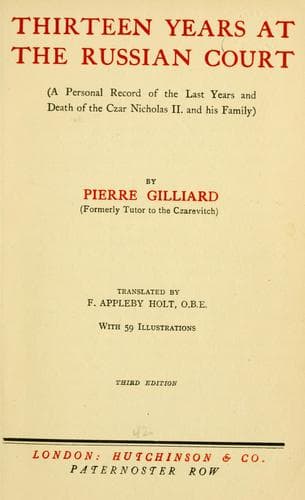
Thirteen years at the Russian court: (a personal record of the last years and death of the Czar Nicholas II. and his family)Gilliard, Pierre
History
Thirteen years at the Russian court: (a personal record of the last years and death of the Czar Nicholas II. and his family)
Gilliard, Pierre
Nicholas II, Emperor of Russia, 1868-1918; Romanov, House of; Soviet Union -- History -- Revolution, 1917-1921 -- Personal narratives
[61] These were Count and Countess Benckendorf, whom their great age
and uncertain state of health prevented from following us; Baroness
Buxhœveden, who was kept back by illness and was to join us at Tobolsk
as soon as she could, and a certain number of servants. Kerensky had
asked the Czar whether he wished Count Benckendorf to be replaced. The
Czar had replied that he would be very glad for General Tatichtchef
to come and share his captivity. On learning his Czar’s wish General
Tatichtchef only allowed himself time to put his affairs in order, and
a few hours later started, valise in hand, for Tsarskoïe-Selo. We found
him in the train at the moment of departure. General Tatichtchef held
no Court appointment; he was one of the Czar’s numerous aides-de-camp.
[62] The four nuns who used to come to sing at first had been replaced
by the choir of one of the Tobolsk churches.
[63] For this tea, which the Czarina poured out herself, Their
Majesties were attended by Countess Hendrikof, lady-in-waiting, General
Tatichtchef, Prince Dolgorouky, and, when their duties permitted,
Mlle. Schneider and Doctor Botkin. I am now the sole survivor of these
evening tea-parties at Tobolsk.
[64] At that time the value of the rouble was about one-fifth of the
normal.
[65] My colleague Mr. Gibbes had joined us at Tobolsk during September.
[66] The Czarina was alluding to the Czar’s abdication.
[67] When the thaw set in the river was impassable for several days; it
was some time before the ferry could be re-started.
[68] Vehicles used by the peasants, and consisting of a large wicker
basket hung from two long poles which take the place of springs. There
are no seats; the passengers sit or lie on the floor.
[69] House belonging to a rich merchant of the town.
[70] I must pay a tribute to the very courageous conduct of the British
consul, Mr. Preston, who did not shrink from open conflict with the
Bolshevik authorities at the risk of compromising his personal safety.
[71] In May, 1918, the Czecho-Slovakian troops (consisting of
volunteers, former prisoners of war), who had by then been developed
by Kerensky into two strong divisions, were strung along the
Trans-Siberian railway between Samara and Vladivostok; preparations
were being made to pass them into France. The German G.H.Q., in an
attempt to prevent these troops from rejoining the allied forces
in Europe, ordered the Bolsheviks to disarm them. Following on
an ultimatum that was rejected by the Czechs, fighting broke out
between them and the Bolshevik troops under German officers. The
Russian volunteer formations lost no time in joining up with the
Czecho-Slovakian troops. Such was the origin of the movement which
began at Omsk and soon spread over the whole of Siberia.
[72] The swastika is an Indian religious symbol consisting of a cross
of equal limbs, their extremities bent to the left.
Public-domain text, read in full here on John Shaqi.
Reviews
Reviews
No reviews yet
Be the first to share your thoughts on this work.
Elsewhere in the archive
Join the Discussion
Join the discussion
Sign in to leave a comment or review.
Sign InorCreate an account