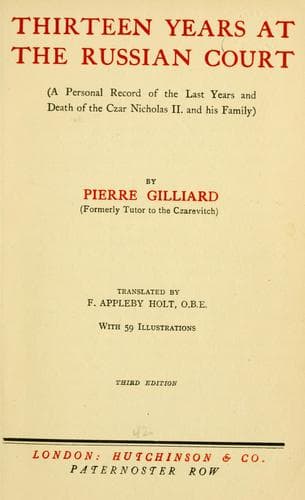
Thirteen years at the Russian court: (a personal record of the last years and death of the Czar Nicholas II. and his family)Gilliard, Pierre
History
Thirteen years at the Russian court: (a personal record of the last years and death of the Czar Nicholas II. and his family)
Gilliard, Pierre
Nicholas II, Emperor of Russia, 1868-1918; Romanov, House of; Soviet Union -- History -- Revolution, 1917-1921 -- Personal narratives
Thus, by the admission of the Germans themselves, if there had been
no Russian Revolution the war would have ended in the autumn of 1917
and millions of human lives would have been spared. Do we realise what
would have been the force of a treaty of Versailles signed by the
Entente, including Russia! Germany, seized in a vice, would not have
been able to escape the fate of the vanquished. The consequences of the
Russian Revolution (Bolshevism) have thrown Russia into the arms of
Germany. She is still there. Germany alone is in a position to organise
and exploit her immense resources. It is in Russia that Germany is
preparing her revenge against the Entente.
[55] Russia had been engaged in a reorganisation of the army which
increased the number of her divisions and greatly augmented her
striking force.
[56] Professor Fiodorof, realising that every hour’s delay meant less
chance of averting imminent disaster, went to find General V----, who
was one of the most prominent members of the Czar’s staff. He found
him perched on a ladder engaged in fixing a nail in the wall on which
to hang a picture. Fiodorof told him his fears and begged him to see
the Czar at once. But the General called him a “revolution maniac,”
and, picking up his hammer, continued the operation which had been
interrupted by his tiresome visitor.
[57] It was a great misfortune for the Czar Nicholas II. and the
Czarina Alexandra Feodorovna that they ascended the throne so young.
Like Louis XVI. and Marie Antoinette, they could have said, “Guard us,
protect us, O God! We are reigning too young!”
History will ultimately give them their due. What was not written about
Louis XVI. at the time of the French Revolution? What accusations were
levelled against him? Was there any calumny of which he was not the
victim? Yet the children in France learn to-day that “he was honest
and kind, and desired to do good” (Malet, _Révolution et Empire_, p.
312). It will be the same with Nicholas II., with the difference that
he was a victim to his devotion to his country because he rejected all
compromise with the enemy.
[58] Another Imperial residence, twelve miles south-west of Petrograd.
[59] No one can have any idea of what the Czarina suffered during these
days when she was despairing at her son’s bedside and had no news of
the Czar. She reached the extreme limits of human resistance in this
last trial, in which originated that wonderful and radiant serenity
which was to sustain her and her family to the day of their death.
[60] Colonel Kobylinsky shortly before had replaced Colonel
Korovitchenko as Commandant of the palace.
Public-domain text, read in full here on John Shaqi.
Reviews
Reviews
No reviews yet
Be the first to share your thoughts on this work.
Elsewhere in the archive
Join the Discussion
Join the discussion
Sign in to leave a comment or review.
Sign InorCreate an account