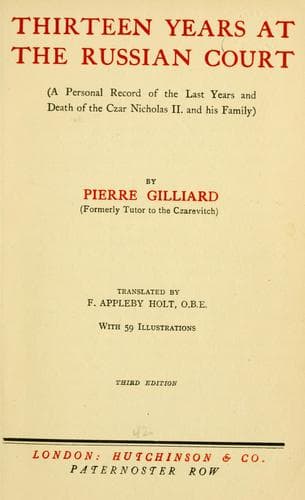
Thirteen years at the Russian court: (a personal record of the last years and death of the Czar Nicholas II. and his family) — John Shaqi
Thirteen years at the Russian court: (a personal record of the last years and death of the Czar Nicholas II. and his family)Gilliard, Pierre
History
Thirteen years at the Russian court: (a personal record of the last years and death of the Czar Nicholas II. and his family)
Gilliard, Pierre
Nicholas II, Emperor of Russia, 1868-1918; Romanov, House of; Soviet Union -- History -- Revolution, 1917-1921 -- Personal narratives
Everything went well at first, and I was beginning to be easy in my
mind, when the accident I had so much feared happened without a word of
warning. The Czarevitch was in the schoolroom standing on a chair, when
he slipped, and in falling hit his right knee against the corner of some
piece of furniture. The next day he could not walk. On the day after the
subcutaneous hæmorrhage had progressed, and the swelling which had
formed below the knee rapidly spread down the leg. The skin, which was
greatly distended, had hardened under the force of the extravasated
blood, which pressed on the nerves of the leg and thus caused shooting
pains, which grew worse every hour.
I was thunderstruck. Yet neither the Czar nor the Czarina blamed me in
the slightest. So far from it, they seemed to be intent on preventing me
from despairing of a task my pupil’s malady made so perilous. As if they
wished by their example to make me face the inevitable ordeal, and
enlist me as an ally in the struggle they had carried on so long, they
associated me in their anxieties with a truly touching kindness.
The Czarina was at her son’s side from the first onset of the attack.
She watched over him, surrounding him with her tender love and care and
trying by a thousand attentions to alleviate his sufferings. The Czar
came the moment he was free. He tried to comfort and amuse the boy, but
the pain was stronger than his mother’s caresses or his father’s
stories, and the moans and tears began once more. Every now and then the
door opened and one of the Grand-Duchesses came in on tip-toe and kissed
her little brother, bringing a gust of sweetness and health into the
room. For a moment the boy would open his great eyes, round which the
malady had already painted black rings, and then almost immediately
close them again.
One morning I found the mother at her son’s bedside. He had had a very
bad night. Dr. Derevenko was anxious, as the hæmorrhage had not been
stopped and his temperature was rising. The inflammation had spread
further and the pain was even worse than the day before. The Czarevitch
lay in bed groaning piteously. His head rested on his mother’s arm, and
his small, deathly-white face was unrecognisable. At times the groans
ceased and he murmured the one word “Mummy!” in which he expressed all
his sufferings and distress. His mother kissed him on the hair,
forehead, and eyes, as if the touch of her lips could have relieved his
pain and restored some of the life which was leaving him. Think of the
tortures of that mother, an impotent witness of her son’s martyrdom in
those hours of mortal anguish--a mother who knew that _she herself_ was
the cause of his sufferings, that _she_ had transmitted to him the
terrible disease against which human science was powerless! _Now_ I
understood the secret tragedy of her life! How easy it was to
reconstruct the stages of that long Calvary.
CHAPTER IV
THE CZARINA, ALEXANDRA FEODOROVNA
Public-domain text, read in full here on John Shaqi.
Reviews
Reviews
No reviews yet
Be the first to share your thoughts on this work.
Join the Discussion
Join the discussion
Sign in to leave a comment or review.
Sign InorCreate an account