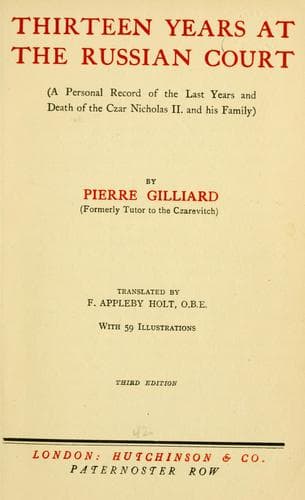
Thirteen years at the Russian court: (a personal record of the last years and death of the Czar Nicholas II. and his family)Gilliard, Pierre
History
Thirteen years at the Russian court: (a personal record of the last years and death of the Czar Nicholas II. and his family)
Gilliard, Pierre
Nicholas II, Emperor of Russia, 1868-1918; Romanov, House of; Soviet Union -- History -- Revolution, 1917-1921 -- Personal narratives
Alexis Nicolaïevitch was the centre of this united family, the focus of
all its hopes and affections. His sisters worshipped him and he was his
parents’ pride and joy. When he was well the palace was, as it were,
transformed. Everyone and everything seemed bathed in sunshine. Endowed
with a naturally happy disposition, he would have developed quite
regularly and successfully had he not been kept back by his infirmity.
Each of his crises meant weeks and sometimes months of the closest
attention, and when the hæmorrhage had been heavy it was followed by a
condition of general anæmia which made all hard work impossible for him,
sometimes for a considerable period. Thus the interludes between attacks
were all that were available, and, in spite of his quick brain, this
made teaching a difficult matter.
The Grand-Duchesses were charming--the picture of freshness and health.
It would have been difficult to find four sisters with characters more
dissimilar and yet so perfectly blended in an affection which did not
exclude personal independence, and, in spite of contrasting
temperaments, kept them a most united family. With the initials of their
Christian names they had formed a composite Christian name, Otma, and
under this common signature they frequently gave their presents or sent
letters written by one of them on behalf of all.
I am sure I shall be forgiven for allowing myself the pleasure of
recording some personal memories here--memories which will enable me to
recall these girls in all the bloom and spontaneous enthusiasms of their
youth. I might almost say their childhood. For these were girls who fell
victims to a dreadful fate at a time when others are blossoming into
womanhood.
The eldest, Olga Nicolaïevna, possessed a remarkably quick brain. She
had good reasoning powers as well as initiative, a very independent
manner, and a gift for swift and entertaining repartee. She gave me a
certain amount of trouble at first, but our early skirmishes were soon
succeeded by relations of frank cordiality.
She picked up everything extremely quickly, and always managed to give
an original turn to what she learned. I well remember how, in one of our
first grammar lessons, when I was explaining the formation of the verbs
and the use of the auxiliaries, she suddenly interrupted me with:
“I see, monsieur. The auxiliaries are the servants of the verbs. It’s
only poor ‘avoir’ which has to shift for itself.”
She read a good deal apart from her lessons. When she grew older, every
time I gave her a book I was very careful to indicate by notes in the
margin the passages or chapters she was to leave out. I used to give her
a summary of these. The reason I put forward was the difficulty of the
text or the fact that it was uninteresting.
An omission of mine cost me one of the most unpleasant moments in my
professional career, but, thanks to the Czar’s presence of mind, the
incident ended better than I could have hoped.
Public-domain text, read in full here on John Shaqi.
Reviews
Reviews
No reviews yet
Be the first to share your thoughts on this work.
Join the Discussion
Join the discussion
Sign in to leave a comment or review.
Sign InorCreate an account