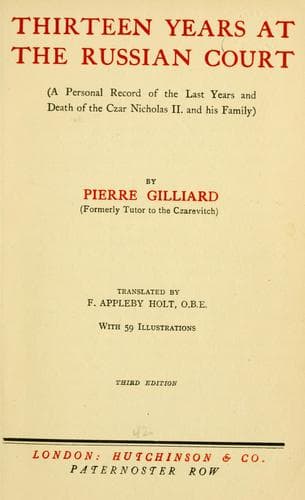
Thirteen years at the Russian court: (a personal record of the last years and death of the Czar Nicholas II. and his family)Gilliard, Pierre
History
Thirteen years at the Russian court: (a personal record of the last years and death of the Czar Nicholas II. and his family)
Gilliard, Pierre
Nicholas II, Emperor of Russia, 1868-1918; Romanov, House of; Soviet Union -- History -- Revolution, 1917-1921 -- Personal narratives
About the end of May there were rumours at Court that the Grand-Duchess
Olga Nicolaïevna was about to be betrothed to Prince Carol of
Rumania.[18] She was then eighteen and a half. The parents on both sides
seemed in favour of the match, which was very desirable at that moment
on political grounds also. I knew that M. Sazonoff, the Minister for
Foreign Affairs, was doing his utmost to bring about the betrothal and
that the final arrangements were to be made during a visit which the
Russian Imperial family were to pay to Rumania in the immediate future.
One day at the beginning of June when I was alone with Olga Nicolaïevna
she suddenly asked me a question with that confident and disingenuous
frankness which was all her own and the legacy of the relations which
had been established between us when she was quite a little girl:
“Tell me the truth, monsieur: do you know why we are going to Rumania?”
In some confusion I replied:
“I believe it’s a courtesy visit. The Czar is going to return the visit
the King of Rumania paid him some time back.”
“Oh, that’s the official reason ... but what’s the real reason? I know
you are not supposed to know, but I’m sure everyone is talking about it
and that you know it....”
As I nodded in assent, she added:
“All right! But if I don’t wish it, it won’t happen. Papa has promised
not to make me ... and I don’t want to leave Russia.”
“But you could come back as often as you like.”
“I should still be a foreigner in my own country. I’m a Russian, and
mean to remain a Russian!”
On June 13th we embarked on the Imperial yacht _Standard_ at Yalta, and
the next morning we arrived at Constanza, the great Rumanian port on the
Black Sea where the celebrations were to take place. On the quay a
company of infantry with its colours and band received us with military
honours, while a battery of artillery posted on the hill above the fort
gave us the prescribed salute. All the ships in the harbour had their
flags out.
Their Majesties were received by the old King Carol, Queen Elizabeth
(“Carmen Sylva”), and the princes and princesses of the royal family.
After the customary presentations we went to the Cathedral, where a _Te
Deum_ was celebrated by the Bishop of the Lower Danube. At one o’clock
the members of the two families took luncheon together privately, while
the suite were the guests of the President of the Council of Ministers.
The royal luncheon was served in the pavilion which “Carmen Sylva” had
had built at the pierhead. It was one of her favourite residences, and
she spent a considerable part of every year there. She was fond of
sitting for hours, “listening to the sea,” on the terrace which seemed
suspended between the sky and the waves, where the great sea-birds only
could break in on her solitude.
In the afternoon Their Majesties gave an At Home on board the _Standard_
and then attended a great review.
Public-domain text, read in full here on John Shaqi.
Reviews
Reviews
No reviews yet
Be the first to share your thoughts on this work.
Join the Discussion
Join the discussion
Sign in to leave a comment or review.
Sign InorCreate an account