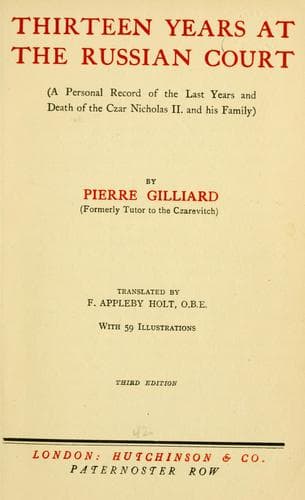
Thirteen years at the Russian court: (a personal record of the last years and death of the Czar Nicholas II. and his family) — John Shaqi
Thirteen years at the Russian court: (a personal record of the last years and death of the Czar Nicholas II. and his family)Gilliard, Pierre
History
Thirteen years at the Russian court: (a personal record of the last years and death of the Czar Nicholas II. and his family)
Gilliard, Pierre
Nicholas II, Emperor of Russia, 1868-1918; Romanov, House of; Soviet Union -- History -- Revolution, 1917-1921 -- Personal narratives
“Do you know, I’ve just been talking to M. Poincaré about you?” he said
in his usual affable manner. “He had spoken to Alexis and asked me who
had taught him French. He is a remarkable man, with a splendid
intellect, and a brilliant talker. That’s always useful; but what I like
most is that there is nothing of the diplomat about him.[26] He is not
reticent, but plain-spoken and frank, and wins one’s confidence at once.
If only we could do without diplomacy humanity would make immense
strides.”
On July 23rd the President left Cronstadt for Stockholm, immediately
after a dinner given in Their Majesties’ honour on the _La France_.
The next day, to our utter amazement, we learned that Austria had
presented an ultimatum to Serbia on the previous evening.[27] I met the
Czar in the park in the afternoon. He was preoccupied, but did not seem
anxious.
On the 25th an Extraordinary Council was held at Krasnoïe-Selo in the
Czar’s presence. It was decided to pursue a policy of dignified but firm
conciliation. The Press was extremely angry at the step taken by
Austria.
The next few days the tone of the Press became increasingly violent.
Austria was accused of desiring to annihilate Serbia. Russia could not
let the little Slav state be overwhelmed. She could not tolerate an
Austro-Hungarian supremacy in the Balkans. The national honour was at
stake.
Yet while tempers were rising and the diplomats were setting the
machinery of all the chancellories in motion, heartrending telegrams
left Alexandria Cottage for distant Siberia, where Rasputin was slowly
recovering from his wound in the hospital at Tioumen.[28] They were
nearly all of the same tenor: “We are horrified at the prospect of war.
Do you think it is possible? Pray for us. Help us with your counsel.”
Rasputin would reply that war must be avoided at any cost if the worst
calamities were not to overtake the dynasty and the Empire.
This advice was consonant with the dearest wish of the Czar, whose
pacific intentions could not be doubted for a moment. We had only to see
him during that terrible last week of July to realise what mental and
moral torture he had passed through. But the moment had come when the
ambition and perfidy of Germany were to steel him against his own last
hesitation and sweep everything with them into the whirlpool.
In spite of all the offers of mediation and the fact that the Russian
Government had suggested closing the incident by direct negotiations
between St. Petersburg and Vienna, we learned on July 29th that general
mobilisation had been ordered in Austria. The next day we heard of the
bombardment of Belgrade, and on the following day Russia replied with
the mobilisation of her whole army. In the evening of that day Count
Pourtalès, the German Ambassador at St. Petersburg, called to inform M.
Sazonoff that his Government would give Russia twelve hours in which to
stop her mobilisation, failing which Germany would mobilise in turn.[29]
Public-domain text, read in full here on John Shaqi.
Reviews
Reviews
No reviews yet
Be the first to share your thoughts on this work.
Join the Discussion
Join the discussion
Sign in to leave a comment or review.
Sign InorCreate an account