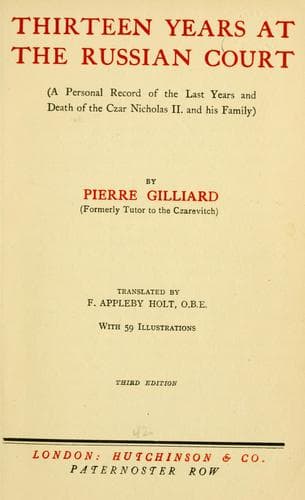
Thirteen years at the Russian court: (a personal record of the last years and death of the Czar Nicholas II. and his family) — John Shaqi
Thirteen years at the Russian court: (a personal record of the last years and death of the Czar Nicholas II. and his family)Gilliard, Pierre
History
Thirteen years at the Russian court: (a personal record of the last years and death of the Czar Nicholas II. and his family)
Gilliard, Pierre
Nicholas II, Emperor of Russia, 1868-1918; Romanov, House of; Soviet Union -- History -- Revolution, 1917-1921 -- Personal narratives
The Czarina’s favourite lucky charm, the “Swastika” 276
The room in Ipatief’s house in which the Imperial family and
their companions were put to death 282
Mine-shaft where the ashes were thrown 286
The search in the mine-shaft 286
M. Sokoloff examining the ashes nearest to the mine-shaft 290
M. Sokoloff examining traces of fire at foot of an old pine 290
Dr. Botkin, who was killed with the Imperial family 294
A group taken at Tobolsk 294
Thirteen Years at the Russian Court
CHAPTER I
MY FIRST LESSONS AT THE COURT
(AUTUMN, 1905)
In the autumn of 1904 I accepted a proposal which had been made to me to
go to Duke Sergius of Leuchtenberg as French professor.
My pupil’s father, Duke George of Leuchtenberg, was the grandson of
Eugène de Beauharnais; through his mother, the Grand-Duchess Marie
Nicolaïevna, daughter of Nicholas I., he was a cousin of the Czar
Nicholas II.
At the time the family were at the small estate they possessed on the
shores of the Black Sea. They spent the whole winter there. It was there
that we were surprised by the tragic events of the spring of 1905 and
passed through many a poignant hour owing to the revolt of the Black Sea
Fleet, the bombardment of the coast, the series of pogroms, and the
violent acts of repression which followed. From the very start Russia
showed herself to me under a terrible and menacing aspect, a presage of
the horrors and sufferings she had in store for me.
At the beginning of June the family took up their residence in the
attractive Villa Sergievskaïa Datcha, which the Duke possessed at
Peterhof. The contrast was most striking as we left the barren coast of
the southern Crimea, with its little Tatar villages snuggling in the
mountains and its dusty cypresses, for the splendid forests and
delicious fresh breezes of the shores of the Gulf of Finland.
Peterhof had been the favourite residence of its founder, Peter the
Great. It was there that he rested from the exhausting work of building
St. Petersburg, the city which at his command rose from the marshes at
the mouth of the Neva as if by enchantment--a city destined to rival the
great European capitals.
Everything about Peterhof recalls its creator. First of all there is
Marly in which he resided for some time--a “maisonnette” out in the
water on an isthmus of land separating two great lakes. Then comes the
Hermitage, by the shores of the gulf where he liked to treat his helpers
to banquets where the wine flowed freely. There is Monplaisir, a
building in the Dutch style with a terrace sheer above the sea. It was
his favourite residence. How curious that this “landsman” loved the sea
so much! Last comes the Great Palace, which, with its lakes and the
superb views in its park, he meant to rival the splendours of
Versailles.
Public-domain text, read in full here on John Shaqi.
Reviews
Reviews
No reviews yet
Be the first to share your thoughts on this work.
Join the Discussion
Join the discussion
Sign in to leave a comment or review.
Sign InorCreate an account