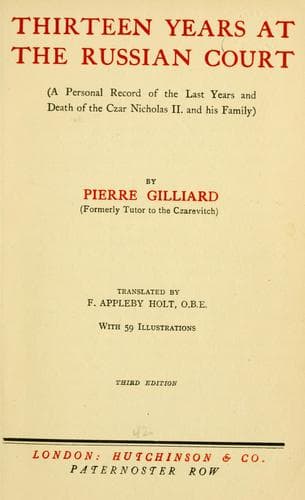
Thirteen years at the Russian court: (a personal record of the last years and death of the Czar Nicholas II. and his family)Gilliard, Pierre
History
Thirteen years at the Russian court: (a personal record of the last years and death of the Czar Nicholas II. and his family)
Gilliard, Pierre
Nicholas II, Emperor of Russia, 1868-1918; Romanov, House of; Soviet Union -- History -- Revolution, 1917-1921 -- Personal narratives
For several months the Czarina had been urging the Czar to take this
step, but he had stood out against her suggestion as he did not like the
idea of relieving the Grand-Duke Nicholas of the post he had given him.
When the war broke out his first impulse had been to put himself at the
head of his army, but, yielding to the representations of his Ministers,
he had abandoned an idea which was very close to his heart. He had
always regretted it, and now that the Germans had conquered all Poland
and were advancing on Russian soil, he considered it nothing less than
criminal to remain away from the front and not take a more active part
in the defence of his country.
The Czar had returned from G.H.Q. on July 11th, and spent two months at
Tsarskoïe-Selo before making up his mind to this new step. I will relate
a conversation I had with him on July 16th, as it shows quite clearly
what were the ideas that inspired him at that time. On that day he had
joined Alexis Nicolaïevitch and myself in the park, and had just been
telling his son something about his recent visit to the army. Turning to
me, he added:
“You have no idea how depressing it is to be away from the front. It
seems as if everything here saps energy and enfeebles resolution. The
most pessimistic rumours and the most ridiculous stories are accepted
and get about everywhere. Folk here care nothing except for intrigues
and cabals, and regard low personal interests only. Out at the front men
fight and die for their country. At the front there is only one
thought--the determination to conquer. All else is forgotten, and, in
spite of our losses and our reverses, everyone remains confident. Any
man fit to bear arms should be in the army. Speaking for myself, I can
never be in too much of a hurry to be with my troops.”[38]
The Czarina was able to take advantage of this great ambition. She set
herself to overcome the scruples which considerations of another
character inspired. She desired the removal of the Grand-Duke Nicholas,
whom she accused of secretly working for the ruin of the Czar’s
reputation and prestige and for a palace revolution which would further
his own ends. On the strength of certain information she had received
from Madame Wyroubova, she was also persuaded that G.H.Q. was the centre
of a plot, the object of which was to seize her daring the absence of
her husband and confine her in a convent.
Public-domain text, read in full here on John Shaqi.
Reviews
Reviews
No reviews yet
Be the first to share your thoughts on this work.
Elsewhere in the archive
Join the Discussion
Join the discussion
Sign in to leave a comment or review.
Sign InorCreate an account