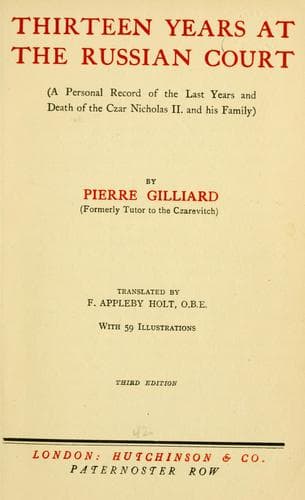
Thirteen years at the Russian court: (a personal record of the last years and death of the Czar Nicholas II. and his family)Gilliard, Pierre
History
Thirteen years at the Russian court: (a personal record of the last years and death of the Czar Nicholas II. and his family)
Gilliard, Pierre
Nicholas II, Emperor of Russia, 1868-1918; Romanov, House of; Soviet Union -- History -- Revolution, 1917-1921 -- Personal narratives
The Czar, on the other hand, had full confidence in the loyalty of the
Grand-Duke Nicholas. He considered him incapable of any criminal action,
but he was compelled to admit his complicity in the intrigue against the
Czarina. Yet he did not give way until the imperious instinct urging him
to put himself at the head of his army had become an obligation of
conscience. By intervening personally in the struggle he hoped to show
the world that the war would be fought out to the bitter end and prove
his own unshakable faith in ultimate victory. In this tragic hour he
thought it was his duty to stake his own person, and as head of the
state to assume the full burden of responsibility. By his presence among
the troops he wished to restore their confidence, for their _morale_ had
been shaken by the long series of reverses, and they were tired of
fighting against an enemy whose strength consisted principally in the
superiority of his armament.
In spite of the recent retreats, the prestige of the Grand-Duke Nicholas
was still considerable in Russia. During this first twelve months of the
war he had given proof of resolution and an iron will. The fact that he
was deprived of his command in times of defeat indicated that he was
held responsible, and was bound to be interpreted as a punishment, as
unjust on the merits as insulting to his honour. The Czar fully realised
all this, and only decided as he did much against his will. His first
idea had been to keep the Grand-Duke with him at G.H.Q., but that would
have made the position of the ex-Generalissimo somewhat delicate. The
Czar decided to appoint him Lieutenant-General of the Caucasus and
Commander-in-Chief of the army operating against the Turks.
The Czar communicated his decision to take over the Supreme Command to
his Ministers at a council which took place at Tsarskoïe-Selo a few days
before his departure for G.H.Q. The news threw most of those present
into utter consternation, and they did their best to dissuade him from
his project. They pointed to the grave difficulties in the way of public
business if the head of the state was to spend practically all his time
at G.H.Q., more than five hundred miles from the seat of government.
They referred to his innumerable duties and asked him not to take new
and crushing responsibilities upon himself. In the last resort they
begged him not to place himself at the head of his troops at a moment so
critical. In case of failure he was running a risk of exposing himself
to attacks which would undermine his prestige and authority.
Yet the Czar was not to be moved. Several members of his immediate
_entourage_ made several further attempts to convince him, but these
failed also, and on the evening of September 4th he left for Mohileff,
where G.H.Q. was established at that time. The next day he signed the
_Prikase_, in which he announced to the troops that he was taking
command in person, and at the foot he added in his own hand:
Public-domain text, read in full here on John Shaqi.
Reviews
Reviews
No reviews yet
Be the first to share your thoughts on this work.
Elsewhere in the archive
Join the Discussion
Join the discussion
Sign in to leave a comment or review.
Sign InorCreate an account