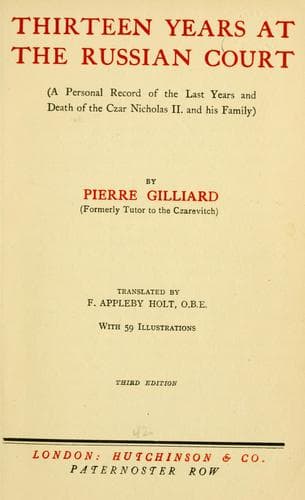
Thirteen years at the Russian court: (a personal record of the last years and death of the Czar Nicholas II. and his family)Gilliard, Pierre
History
Thirteen years at the Russian court: (a personal record of the last years and death of the Czar Nicholas II. and his family)
Gilliard, Pierre
Nicholas II, Emperor of Russia, 1868-1918; Romanov, House of; Soviet Union -- History -- Revolution, 1917-1921 -- Personal narratives
“With unshakable faith in the goodness of God and firm confidence in
final victory we shall accomplish our sacred duty in defending our
Fatherland to the end, and we shall never let the soil of Russia be
outraged.”
He was repeating the oath he had taken at the outset of the war and
casting his crown into the arena.
In France and England this announcement came as a surprise which was
not without a certain element of apprehension, but this action was
regarded as a pledge which irrevocably associated the Russian Empire, in
the person of its Czar, with the fortunes of the Entente, and this at a
moment when a series of defeats would have been grounds for fearing
separatist tendencies. All the great newspapers of the Allied countries
emphasised the importance of this decision. It was hoped that it would
have a considerable effect on the _morale_ of the Russian army and
contribute to further the cause of final victory. In Russia the whole
Press raised a shout of triumph, but in sober reality opinion about the
wisdom of changing the command was sharply divided at first. In the army
itself we shall see that the presence of the Czar helped to raise the
spirits and courage of the men and gave the campaign a new impetus.
History will some day reveal the political and military consequences of
this step, which was certainly an act of courage and faith on the part
of the Czar himself.
* * * * *
As I had feared, the apparent indifference with which Rasputin had been
treated during the winter had only been temporary, and at the time of
the disasters in May there was a revival of his influence, which grew
steadily stronger. The change is easily explained. At the beginning of
the war the Czar and Czarina were utterly obsessed by the greatness of
their task, and had passed through hours of exaltation in the knowledge
of the love they bore their people, a love they felt was reciprocated.
That fervent communion had filled them with hope. They believed that
they were really the centre of that great national movement which swept
over the whole of Russia. The military events of the following months
had not shaken their courage. They had maintained their ardent faith
[Illustration: THE CZARINA.]
[Illustration: THE FOUR GRAND-DUCHESSES.
{_Facing page 140._]
in that spring offensive which was to bring about the final success of
the Russian armies.
When the great catastrophe followed they passed through a time of
unspeakable anguish. In her sorrow the Czarina was bound to feel
impelled to seek moral support from him whom she already regarded not
only as the saviour of her son, but as the representative of the people,
sent by God to save Russia and her husband also.
Public-domain text, read in full here on John Shaqi.
Reviews
Reviews
No reviews yet
Be the first to share your thoughts on this work.
Elsewhere in the archive
Join the Discussion
Join the discussion
Sign in to leave a comment or review.
Sign InorCreate an account